
Inside this article :
Kubernetes is no longer experimental infrastructure plumbing. In 2026, Kubernetes has become central to how organizations design and deliver AI capabilities, manage stateful workloads at scale, and simplify developer experience through platform engineering. Yet most organizations are running mission-critical systems on a platform they still treat as infrastructure—not the strategic operating layer controlling speed, security, and efficiency.
This disconnect creates real risk. 45% of security incidents come from misconfigurations, and 33% identify vulnerabilities as their top concern. Meanwhile, organizations now run 20+ clusters across 5+ cloud environments, with 55% having adopted platform engineering in 2025 and 58% running AI workloads on Kubernetes. If you’re still treating Kubernetes as a legacy platform, you’re already behind.
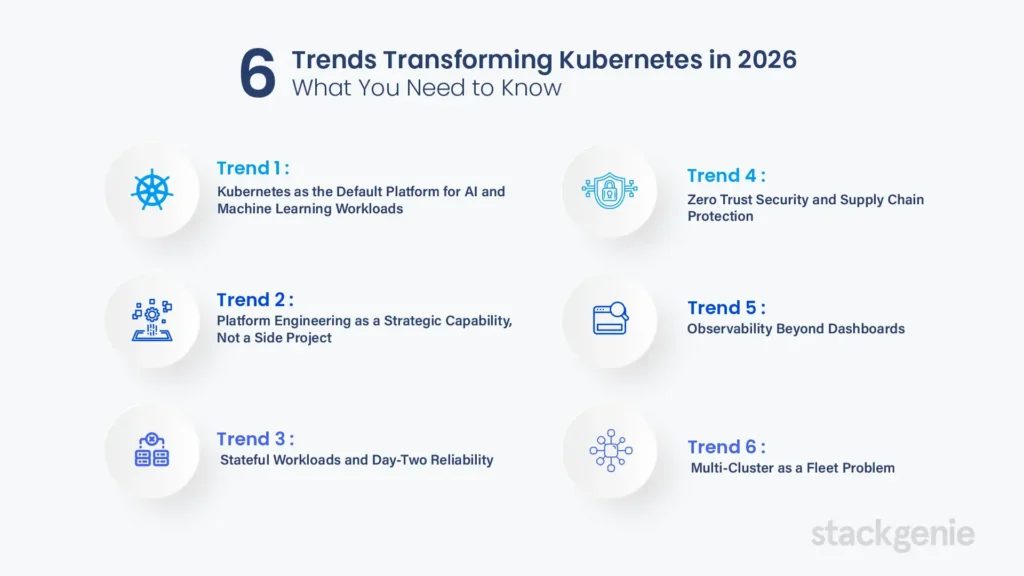
The Six Trends Transforming Kubernetes in 2026: What You Need to Know
Kubernetes consulting services are evolving too. It’s no longer about basic containerization and Helm charts. Modern Kubernetes consulting addresses platform engineering, AI workload optimization, stateful data protection, and multi-cluster fleet management. The consultants who understand these shifts are the ones delivering real competitive advantage.
This guide covers six critical areas reshaping Kubernetes in 2026—and what strategic consulting approaches matter most:
Trend 1: Kubernetes as the Default Platform for AI and Machine Learning Workloads
In November 2025, CNCF launched the Kubernetes AI Conformance Program, validating that Kubernetes is now the de facto platform for production AI workloads. This represents a fundamental shift from viewing Kubernetes as infrastructure for stateless microservices to viewing it as the operating system for intelligent systems.
The reality in 2026: Organizations are building entire AI agent teams running on Kubernetes clusters. Each agent deploys as a microservice with sophisticated orchestration, auto-scaling, and resource optimization. GPU scheduling, model placement across nodes, and intelligent resource sharing have become foundational requirements—not nice-to-haves.
Kubernetes consulting in this space means understanding MLOps platforms, coordinating bursty, resource-intensive training jobs alongside high-volume inference services, and optimizing expensive accelerator hardware through intelligent bin-packing. 58% of organizations are running AI workloads on Kubernetes, and this percentage climbs daily.
Trend 2: Platform Engineering as a Strategic Capability, Not a Side Project
Gartner forecasts 80% adoption by 2026, up from 45% in 2022, with 92% of CIOs planning AI integrations into platforms. Yet most organizations treat platform engineering as something their infrastructure team handles separately from application teams.
The teams winning in 2026 are building Internal Developer Platforms (IDPs) that abstract Kubernetes complexity while preserving power and flexibility. High-maturity platform teams report 40-50% reductions in cognitive load for developers. Tools like Backstage, Port, and Kratix provide self-service infrastructure through GitOps and declarative APIs, creating golden paths for common deployment patterns—web apps, ML models, data pipelines.
Smart Kubernetes consulting now includes designing and implementing IDPs that improve developer experience while maintaining governance and compliance. This is how enterprises achieve velocity at scale—through simplicity and empowerment, not bureaucracy.
Trend 3: Stateful Workloads and Day-Two Reliability
For years, Kubernetes operated best with stateless applications. Advances in Operators, custom resource definitions, and StatefulSets have changed this. In 2026, operational maturity is measured by how consistently organizations protect and restore stateful services.
The critical shift: Many enterprises still rely on mixed storage types, increasing the importance of clear safeguards and recovery strategies across all environments. Leaders focus not only on Day One deployment but on Day Two reliability, cross-cluster consistency, data-level protection, and recovery at the pace required by modern AI-driven applications.
Kubernetes consulting must address stateful workload strategies, disaster recovery planning, and data protection frameworks. These capabilities directly impact your ability to run mission-critical databases, message queues, and data pipelines on Kubernetes—not on separate infrastructure.
Trend 4: Zero Trust Security and Supply Chain Protection
45% of security incidents come from misconfigurations. Supply chain attacks have made artifact signing, image scanning, and admission controllers non-negotiable. Organizations deploying Kubernetes in 2026 need security gates at every stage: Build. Registry. Admission. Runtime.
Docker made 1,000+ hardened images free and open source in December 2025, reflecting the industry shift toward minimal, purpose-built container images. Organizations are moving away from bloated base images to reduce CVE exposure dramatically while improving performance. Zero Trust is now mainstream—”never trust, always verify” is the Kubernetes security mantra.
Modern Kubernetes consulting establishes comprehensive security frameworks, container hardening strategies, and policy-as-code implementations that create resilient, auditable systems.
Trend 5: Observability Beyond Dashboards
In 2026, observability goes far beyond dashboards and alerts. It combines OpenTelemetry as the vendor-neutral standard, low-level observability with eBPF, business-aligned reliability (SLOs), cost-aware data management, and AI-powered context.
Teams that treat observability as a product—not a side project—are better positioned to run resilient, secure, and cost-effective Kubernetes platforms. 93% of organizations are using or planning to use GitOps in 2025, making observability integral to continuous delivery pipelines.
Trend 6: Multi-Cluster as a Fleet Problem
Organizations now run 20+ clusters across 5+ cloud environments. The question isn’t “How do I manage one cluster well?” It’s “How do I manage 20+ clusters consistently?” This requires treating multi-cluster as a fleet problem, not as a series of one-off projects.
Key capabilities must work across your entire cluster fleet: governance, security, observability, and cost controls. Mature organizations in 2026 think in terms of applications spanning many clusters instead of apps per cluster. Developers interact with a single platform for workloads running in dozens of locations worldwide.
Market Reality: The global Kubernetes market is projected to grow from $1.7 billion in 2023 to $11.78 billion by 2032 at a CAGR of 23.4%. Growth is accelerating, not slowing.
How Modern Kubernetes Consulting Addresses 2026 Priorities
Phase 1: Strategic Maturity Assessment
Professional engagements begin with honest evaluation of your Kubernetes maturity across six dimensions: platform engineering, security, observability, cost controls, AI workload readiness, and multi-cluster operations. This assessment identifies which gaps are slowing your teams down most.
Phase 2: Prioritized Roadmap Development
Rather than attempting everything, smart consulting focuses on 1-2 high-impact areas. For many organizations, that means standardizing the platform and implementing guardrails. Others prioritize AI workload optimization or multi-cluster governance. Your roadmap should reflect your business priorities.
Phase 3: Cross-Functional Implementation
Kubernetes becomes a cross-functional effort between platform, security, FinOps, and data/AI teams. Implementation includes creating shared backlogs around golden paths for common workloads, baseline policies, and cost/efficiency dashboards that everyone understands and owns.
Phase 4: Automation-First Operating Model
Git repository structure, policy-as-code, and automated scanning/reporting pay off across all six trends. The goal isn’t more manual processes—it’s fewer, smarter humans managing more sophisticated systems through automation.
Evaluating Kubernetes Consulting Partners in 2026
Not all consultants understand 2026 realities. Look for partners who can articulate expertise in these areas:
- AI/ML workload optimizationon Kubernetes—GPU scheduling, resource sharing, model lifecycle governance
- Platform engineering maturity—internal developer platforms, GitOps implementations, golden path design
- Stateful workload strategies—data protection, disaster recovery, cross-cluster consistency
- Security automation—policy-as-code, supply chain protection, Zero Trust implementation
- Multi-cluster fleet management—managing 20+ clusters across multiple clouds as a cohesive system
- Observability as a first-class concern—OpenTelemetry, eBPF, SLO-driven reliability
- Cost and efficiency optimization—FinOps practices, resource utilization metrics, meaningful cost controls
Red Flags to Avoid:
Consultants who still treat Kubernetes as “infrastructure plumbing” without understanding its strategic role in AI, platform engineering, and business velocity.** The best partners view Kubernetes as a business enabler, not just a technical tool. Also avoid consultants who don’t emphasize team enablement—the goal is building internal capabilities, not creating permanent dependency.
Your 2026 Kubernetes Action Plan
Stop treating Kubernetes as infrastructure separate from business strategy. Instead, consider this framework:
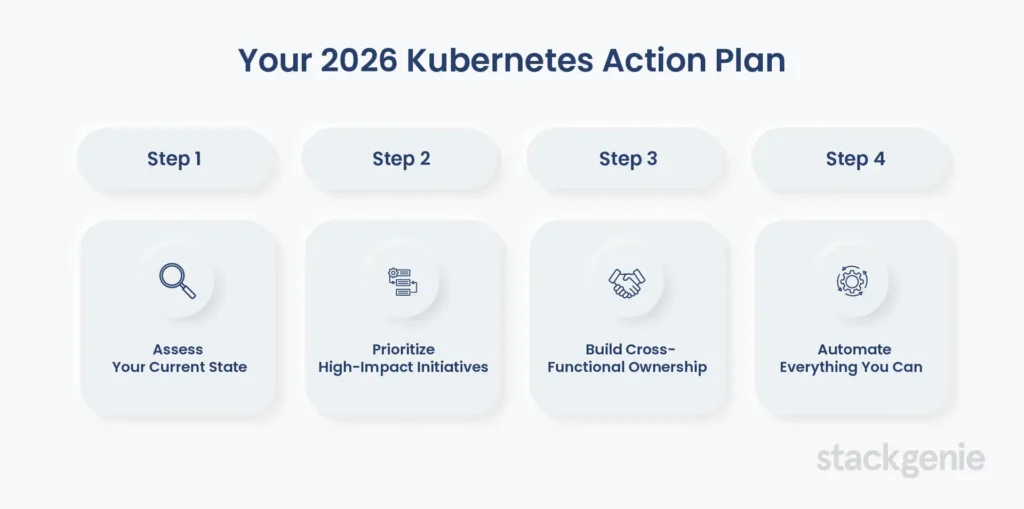
Step 1: Assess Your Current State
Where does your organization stand on platform engineering maturity, security posture, observability capabilities, and cost controls? Which gaps are slowing your teams down most? This honest assessment becomes your starting point.
Step 2: Prioritize High-Impact Initiatives
Don’t try to solve all six trends simultaneously. If 58% of organizations run AI workloads on Kubernetes, perhaps GPU scheduling and resource optimization should be your priority. If you’re managing multiple clusters across clouds, fleet management becomes critical.
Step 3: Build Cross-Functional Ownership
Kubernetes success in 2026 requires collaboration between platform teams, security teams, FinOps specialists, and AI/data teams. Create shared backlogs. Establish metrics everyone understands. Make infrastructure decisions visible to the business.
Step 4: Automate Everything You Can
Manual Kubernetes operations don’t scale to 20+ clusters. Invest in policy-as-code, automated scanning, GitOps pipelines, and AI-assisted observability. Automation isn’t optional—it’s how you run modern infrastructure.
The Bottom Line: Organizations that view Kubernetes as a strategic operating layer—not as infrastructure plumbing—are the ones winning in 2026. They’re standardizing platforms, automating complexity, and building cultures where platform engineering is a competitive advantage.
Conclusion: Kubernetes in 2026 Demands Different Thinking
The Kubernetes platform that solved container orchestration problems five years ago is not the same platform that runs mission-critical AI pipelines, manages stateful databases at scale, and coordinates global multi-cluster fleets in 2026. The technology evolved. The business impact expanded. Your consulting approach needs to reflect this reality.
Organizations are no longer asking “Can we use Kubernetes?” They’re asking “How do we maximize competitive advantage through Kubernetes?” That’s a fundamentally different question—one that requires consulting partners who understand AI workload optimization, platform engineering maturity, enterprise-scale security, and multi-cloud operations as interconnected strategic capabilities, not isolated technical problems.
The maturity gap is real: 45% of security incidents come from misconfiguration. 33% identify vulnerabilities as top concern. 37% delay security updates due to resource constraints. These aren’t signs of Kubernetes failure—they’re signs of organizations treating Kubernetes as a tool rather than as strategic infrastructure that demands different operational models, different team structures, and different consulting approaches.
Your competitors are already moving. In 2026, the question isn’t whether Kubernetes consulting matters. It’s whether you can afford to implement Kubernetes strategy without expert partners who understand these six trends—AI workload optimization, platform engineering, stateful reliability, supply chain security, observability-first operations, and multi-cluster fleet management.
Ready to Transform Your Infrastructure?
StackGenie’s Kubernetes consulting experts help organizations design, implement, and optimize cloud-native infrastructure. Let’s discuss your specific challenges and build a roadmap for success.
About StackGenie: We’re a cloud-native consulting firm specializing in Kubernetes, DevOps, and platform engineering services. Our consultants bring decades of combined experience helping enterprises navigate digital transformation through expert guidance and hands-on implementation.
Talk to our Kubernetes Expert?
Contact Us NowFrequently Asked Questions
1. What is Kubernetes used for in 2026?
Kubernetes in 2026 is used to run AI workloads, manage multi-cluster environments, and automate cloud-native applications, making it a strategic platform for modern infrastructure.
2. Why is Kubernetes important for AI workloads?
Kubernetes enables GPU scheduling, scalable model deployment, and efficient resource utilization, making it ideal for both AI training and inference workloads.
3. What are the key Kubernetes trends in 2026?
Key trends include AI workloads, platform engineering, multi-cluster management, Zero Trust security, advanced observability, and stateful workload support.
4. What is platform engineering in Kubernetes?
Platform engineering involves building internal developer platforms (IDPs) that simplify Kubernetes usage through automation, self-service tools, and standardized workflows.
5. How does Kubernetes support multi-cluster management?
Kubernetes allows organizations to manage multiple clusters across clouds as a unified system, improving scalability, resilience, and global deployment.
6. What are the biggest security challenges in Kubernetes?
The main challenges are misconfigurations, supply chain vulnerabilities, and lack of policy enforcement, which require Zero Trust and policy-as-code solutions.
7. How does observability improve Kubernetes performance?
Observability provides real-time insights using metrics, logs, and traces, helping teams detect issues faster and optimize performance and costs.
8. Why do companies need Kubernetes consulting services in 2026?
Kubernetes consulting helps organizations manage complexity, optimize AI workloads, improve security, and scale efficiently across multi-cloud environments.