

Inside this article :
The Configuration Chaos Nobody Talks About
I have observed many teams implement Kubernetes, and I can tell you that the moment you add a service mesh to your stack, everything changes. Suddenly, you are managing three fragmented systems running in parallel.
1. Git repos holding your application manifests
2. Ingress controllers (NGINX) are manually configured via kubectl or scattered across dashboards
3. Istio VirtualServices and mTLS policies that drift because nobody knows who owns them
The result? You push a code change on Monday, Istio sidecar injection breaks on Tuesday, and by Wednesday, you’re debugging across three different observability dashboards. At the same time, your team blames “it must be a mesh issue.”
The real problem isn’t the tools. It’s the fragmented state.
Last quarter, I worked with an enterprise running 400+ microservices on Istio. Their traffic policies lived in Git. Their NGINX ingress configs? kubectl apply history and Slack messages. Authorization policies? Partially in Helm, partially manual. When they needed to change a routing rule, they’d check four different places, make the change in two, and hope the third was consistent.
Enter GitOps. Enter ArgoCD.
This guide shows you how to unify your entire service mesh infrastructure, traffic policies, sidecar injection, mTLS enforcement, and observability under a single source of truth in Git. And how ArgoCD becomes the agent that ensures your mesh state is always, provably, what you declared.
The Problem: Why Manual Service Mesh Management Breaks at Scale
Before we solve it, let’s be clear about what breaks:
Configuration Drift: Your NGINX ingress controller runs version 1.2.0. Your Istio sidecar uses 1.25. A different team deployed an AuthorizationPolicy last week without a PR. You’re not sure what’s actually running.
Fragmented State: Application configs live in Git. Mesh policies live in kubectl history. Ingress rules live in a YAML file nobody’s touched in 6 months. When something breaks, which one do you check first?
Silent Failures: Istio sidecar injection didn’t work because the namespace label wasn’t applied. NGINX ingress cert-manager integration failed silently. You don’t know until traffic starts failing.
Operational Fatigue: Your platform team spends 40% of their time “fixing” the mesh instead of improving it. Changes require manual verification across tools. Rollbacks are scary because nobody knows what the previous state was.
Identity Misalignment: NGINX ingress uses one identity, Istio another, ArgoCD a third. Authorization “holes” appear because the policies don’t align across layers.
Enter GitOps: The Service Mesh Unification Pattern
GitOps is deceptively simple: your Git repo is the source of truth for all state. For a service mesh, that means:
- NGINX Ingress controllers → Helm charts + custom resources in Git
- Istio installation and policies → Helm releases + CRDs in Git
- Sidecar injection rules → ArgoCD-managed labels + MutatingWebhook configs
- Traffic policies (VirtualServices, DestinationRules, AuthorizationPolicies) → Git-controlled manifests
- Observability → Unified telemetry collection, centralized logging, GitOps-driven alerting
When you commit a change to Git, ArgoCD detects the drift and automatically reconciles it. Your mesh state and Git state are always in sync. Always.
The Technical Architecture: Separating Concerns with ArgoCD
The mistake most teams make: they throw everything (infrastructure + apps + mesh policies) into a single ArgoCD Application. The result? Sync failures cascade. A broken app manifest blocks the entire mesh from updating.
The right approach: Three separate ArgoCD Applications with explicit sync waves.
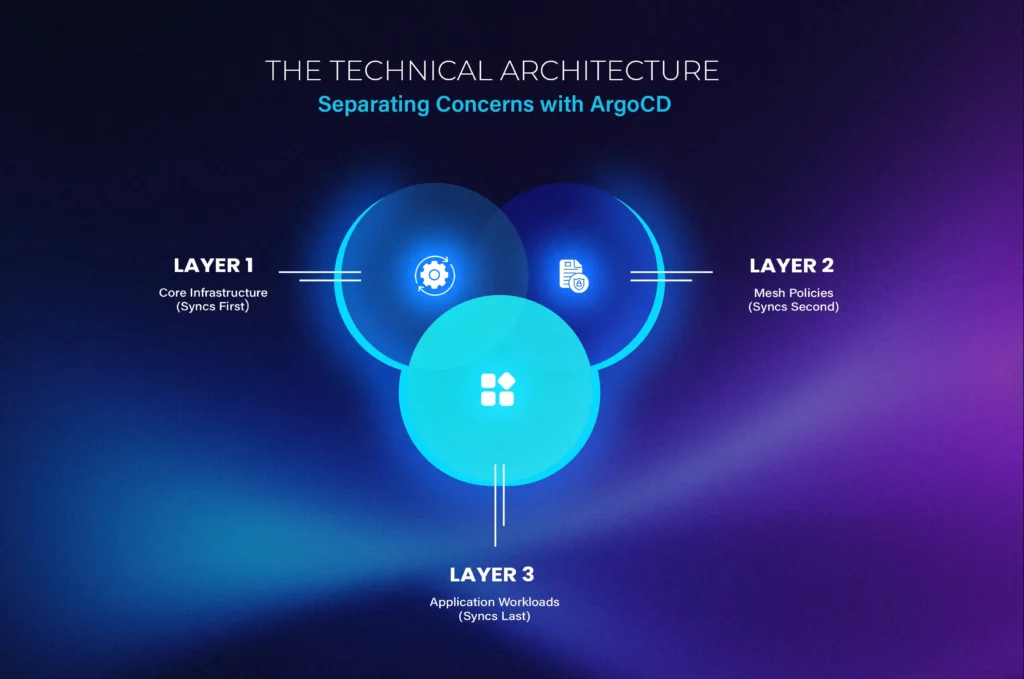
Layer 1: Core Infrastructure (Syncs First)
What this manages:
- NGINX Ingress controller Helm release
- Istio base CRDs and control plane (Istiod)
- Cert-manager for TLS automation
- CNI plugins and network policies
Sync Wave: 0 (runs first)
This foundational layer ensures all infrastructure components are in place and healthy before anything else is deployed. When your core infrastructure is solid, the rest of your mesh can build reliably on top of it.
Layer 2: Mesh Policies (Syncs Second)
What this manages:
- AuthorizationPolicies (mTLS, access control)
- VirtualServices (traffic routing, canaries)
- DestinationRules (load balancing, circuit breaking)
- PeerAuthentication (enforce mTLS)
- Telemetry policies (log collection)
Sync Wave: 1 (runs after core infrastructure is healthy)
This layer handles all the traffic management and security policies that dictate how services communicate. By syncing after the core infrastructure, you ensure Istio is ready to accept these policies without errors.
Layer 3: Application Workloads (Syncs Last)
What this manages:
- Deployments, StatefulSets, DaemonSets
- ConfigMaps, Secrets
- Service definitions
- Sidecar injection happens automatically (via namespace labels applied by Layer 1)
Sync Wave: 2 (runs after mesh is ready to handle traffic)
Your applications arrive last after the infrastructure is ready and mesh policies are enforced. This ensures every pod that spins up automatically gets the correct sidecar injection and traffic policies without manual intervention.
Why this matters: If an app deployment is broken, it doesn’t block your mesh policies from updating. Your infrastructure stays stable while you debug the app. When the app is fixed, it comes back online automatically with the correct mesh policies already in place.
Getting This Architecture Right
Implementing this three-layer separation requires careful planning around:
- Repository structure and team ownership boundaries
- Namespace isolation and RBAC policies
- Custom health checks to ensure each layer is genuinely ready before the next syncs
- Monitoring and alerting when sync waves fail
This is where teams often stumble the theory is sound, but the execution requires deep understanding of ArgoCD internals and Kubernetes networking.
Contact StackGenie for a GitOps architecture review → We help enterprises design sync wave strategies that scale reliably.
Solving the Hidden Complexity: Sidecar Injection, mTLS, and Traffic Routing
Now let’s address the things that silently break:
Sidecar Injection Without Manual Labels
Manual sidecar injection is a common failure point. Teams forget to add the istio-injection=enabled label to namespaces, and sidecars don’t inject. With GitOps, this becomes declarative and auditable.
When your namespace labels are declared in Git and synced by ArgoCD, every pod in that namespace automatically gets the Istio sidecar. If someone tries to remove the label manually, ArgoCD detects the drift within minutes and reapplies it. No surprises. No forgotten configurations.
This isn’t just automation, it’s accountability. Your Git history shows exactly when sidecar injection was enabled for each namespace, who approved it, and why.
Let us help you design namespace and label strategies →
mTLS Enforcement Without Manual Configuration
Manual mTLS policy management creates security holes. Policies added in staging don’t make it to production. Exceptions for legacy systems remain even after migration is complete.
When your PeerAuthentication policies live in Git under version control, mTLS enforcement becomes auditable and reproducible. You can enforce STRICT mode mesh-wide while maintaining PERMISSIVE exceptions for specific namespaces—all declared in Git, all tracked in history.
When you want to tighten security across the organization, you change the policy once in Git, and ArgoCD propagates it consistently. When you need to understand when a security posture changed, you check Git history instead of scanning kubectl logs.
Talk to us about security policy frameworks that scale →
Traffic Routing Policies with Argo Rollouts
This is where GitOps + service mesh gets genuinely powerful. Argo Rollouts lets you define canary deployments directly in your manifests, with the service mesh automatically handling traffic splits.
Instead of manually adjusting VirtualService weights, Argo Rollouts manages traffic progression declaratively. You define your deployment strategy: 10% for 5 minutes, then 50%, then full rollout. The rollout controller automatically updates the service mesh traffic policies.
What happens:
1. You commit a new image tag to Git
2. ArgoCD detects the change and creates a new ReplicaSet
3. Argo Rollouts intercepts and starts the canary: sends 10% of traffic to the new version
4. After 5 minutes (or until error thresholds are hit), increases to 50%
5. After another 5 minutes, full rollout
6. Git, not manual kubectl commands manage all traffic routing rules
These transformations canary deployments from a risky, manual process into a repeatable, auditable pattern. Your entire deployment strategy is version-controlled.
We can help you implement Argo Rollouts with your service mesh →
Best Practices for Scale: Managing 100+ Services Without Losing Your Mind
When you move beyond 50 microservices, ArgoCD needs careful tuning and strategy:
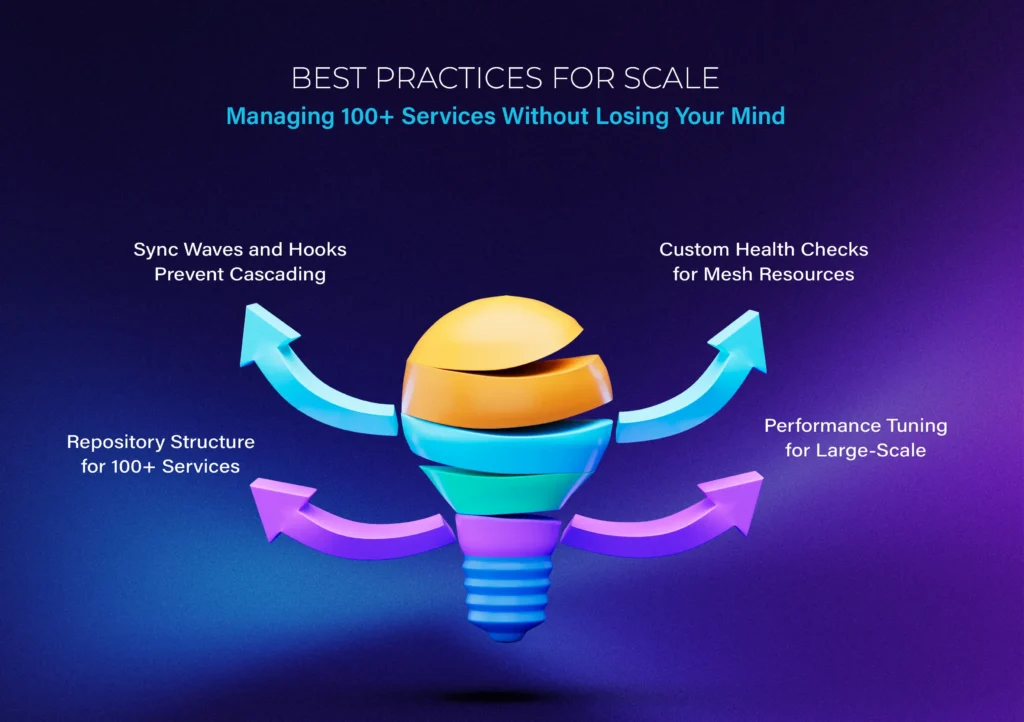
1. Sync Waves and Hooks Prevent Cascading Failures
The key to reliable scaling is ensuring dependencies are ordered correctly. Core infrastructure must be healthy before mesh policies deploy. Mesh policies must be ready before applications arrive.
ArgoCD’s sync waves feature manages this orchestration. When configured correctly, if your NGINX ingress controller fails to install, ArgoCD stops there and doesn’t proceed to install Istio policies or applications.
Post-sync hooks let you verify health at each stage, making sure the mesh is genuinely ready before applications start receiving traffic.
Let us design your sync wave strategy →
2. Custom Health Checks for Mesh Resources
Standard Kubernetes health checks don’t know if Istio is actually working. A PeerAuthentication policy can be “created” but not “accepted” by the mesh control plane.
Custom health checks tell ArgoCD to verify that Istio resources are genuinely healthy, not just created. This prevents a common failure pattern: your YAML is valid, the resources exist, but the mesh silently rejected them.
3. Repository Structure for 100+ Services
As you scale, repository organization matters. Teams managing 100+ microservices typically separate:
- Core Infrastructure (one team, owned by platform)
- Mesh Policies (platform team, cross-cutting concerns)
- Application Workloads (app teams, organized by environment or team)
This structure prevents conflicts when app teams deploy independently. The core infrastructure stays stable. Mesh policies apply uniformly. Apps can iterate fast.
We help structure repos for organization-scale operations →
4. Performance Tuning for Large-Scale Deployments
If you’re syncing 500+ applications, ArgoCD’s default resource limits become a bottleneck. Reconciliation timeouts. Repo server CPU spikes. Sync waves getting stuck.
The solution involves tuning ArgoCD’s core components: increasing parallelism, adjusting reconciliation timeouts, and monitoring the control plane itself.
This isn’t trivial—it requires understanding ArgoCD’s architecture and observability. Many teams discover these limits during production incidents.
Observability: From Fragmented to Unified
Manual mesh management means debugging across dashboards. GitOps means centralized observability:
Instead of:
- “What’s running in NGINX right now?” (check controller logs)
- “Is mTLS actually enforced?” (check Envoy sidecars manually)
- “When did the traffic policy change?” (grep kubectl history)
With GitOps, you have:
- Exact mesh state visible in Git (full history of every policy change)
- ArgoCD dashboard showing what’s synced and what’s drifting
- Envoy configs that provably match your Git declarations
- Unified logging where all mesh events are centralized instead of scattered
When something goes wrong, you don’t debug across three systems. You check Git, verify ArgoCD synced correctly, and confirm Envoy matches the declaration. One clear chain of accountability.
From Uncertainty to Confidence in Infrastructure Management
Successful teams don’t rely on hope; they prioritize verification and accountability.
– Instead of “I hope the sidecar injected correctly,” say, “ArgoCD confirms sidecar injection labels are applied, with Git history documenting changes.”
– Replace “I hope NGINX and Istio stay synchronized” with, “Sync waves ensure NGINX’s health before mesh policies deploy, and both configurations are managed in Git.”
– Rather than “I hope nobody compromised the mTLS policy,” make it clear: “PeerAuthentication is defined in Git, and manual changes are corrected within three minutes.”
– Instead of “I hope the traffic routing works,” assert, “Argo Rollouts manage canaries through Git, allowing me to review the precise weight distribution.”
This shift enhances not just operations but mindset. Your service mesh evolves from an opaque system into a clear, auditable framework, where every change is traceable to a Git commit. Embrace this transformation for greater reliability and control.
Getting Started: Action Plan
1. Separate Your Applications: Create three ArgoCD applications (core infrastructure, mesh policies, app workloads) with explicit sync waves
2. Move Mesh Policies to Git: Export all Istio policies from your cluster into your Git repo under mesh/
3. Define Sync Hooks: Add PreSync and PostSync hooks to verify health at each stage
4. Implement Custom Health Checks: Use ArgoCD custom health rules for Istio/NGINX resources
5. Set Up Observability: Route ArgoCD sync logs + mesh telemetry to a central location (Prometheus, Datadog, or ELK)
6. Test Drift Detection: Manually change a policy in the cluster and watch ArgoCD fix it (takes ~3 minutes by default)
7. Automate Canaries: Use Argo Rollouts to drive traffic via VirtualServices defined in Git
The Bottom Line
Istio and NGINX are powerful. But power without governance is chaos. ArgoCD + GitOps transforms your service mesh from a collection of manual edits and fragmented configs into a declarative, auditable system where state is always provably correct.
For enterprises managing 50+ microservices, this isn’t a nice-to-have. It’s the difference between sleeping at night and getting paged at 2 AM.
The question isn’t whether to adopt GitOps for your service mesh. The question is how quickly you can migrate to it.
Ready to Unify Your Service Mesh?
Managing service mesh complexity at scale requires more than tools,it requires architecture. At StackGenie, we’ve helped enterprise teams across the US and UK architect GitOps-driven service mesh deployments that scale reliably. From ArgoCD sync wave strategies to mTLS automation, we bring 20+ years of real-world DevOps and platform engineering experience.
Let's talk about your service mesh challenges?
Contact Us NowFrequently Asked Questions
1. What is ArgoCD in Kubernetes?
ArgoCD is a GitOps continuous delivery tool for Kubernetes that automates deployments and ensures cluster state matches Git repositories.
2. How does ArgoCD help manage Istio service mesh?
ArgoCD manages Istio configurations declaratively using Git repositories, helping teams eliminate configuration drift and automate traffic policies, mTLS, and sidecar injection.
3. Why is GitOps important for service mesh management?
GitOps provides a single source of truth for Kubernetes infrastructure and service mesh policies, improving consistency, security, and operational reliability.
4. What are ArgoCD sync waves?
Sync waves allow ArgoCD to deploy Kubernetes resources in a controlled order, ensuring infrastructure components are healthy before dependent applications or policies are deployed.
5. How does Argo Rollouts work with Istio?
Argo Rollouts integrates with Istio VirtualServices to automate canary deployments and progressive traffic shifting without manual routing updates.
6. How can teams prevent Kubernetes configuration drift?
Teams can prevent configuration drift by storing Kubernetes manifests and service mesh policies in Git repositories managed by ArgoCD.