

Inside this article :
The Question I Hear Every Month
“Do we really need a service mesh, or can we just use Kubernetes networking?”
It’s the right question. It’s also the wrong question to ask without context.
I’ve spent two decades watching teams deploy Kubernetes, and this decision point comes up time and time again. Teams have been running Kubernetes for 18 months. Traffic is growing. They’re managing 30+ microservices. Suddenly, the simple networking model that worked at a scale of 10 starts breaking down at 100.
Some teams respond by upgrading to Istio or NGINX Service Mesh. Others double down on native Kubernetes networking. The ones that sleep well at night? They made this decision based on honest criteria, not hype.
This guide shows you what native Kubernetes networking actually does, where it breaks, and exactly when a service mesh becomes worth the operational complexity.
What Native Kubernetes Networking Actually Gets You
Let’s start here: native Kubernetes networking is good. It’s actually better than most engineers give it credit for.
When you deploy a Kubernetes Service with type: ClusterIP, you get:
- Service Discovery: DNS resolves service names automatically. Pods find each other without hardcoding IPs.
- Load Balancing: Traffic is distributed across healthy endpoints. Dead pods are removed from the pool.
- Network Policies: You can restrict traffic flow between namespaces and pods.
- Ingress Controllers: External traffic enters your cluster and routes to internal services.
For many workloads, this is sufficient. A small team running 20 microservices with straightforward traffic patterns? Native networking handles it.
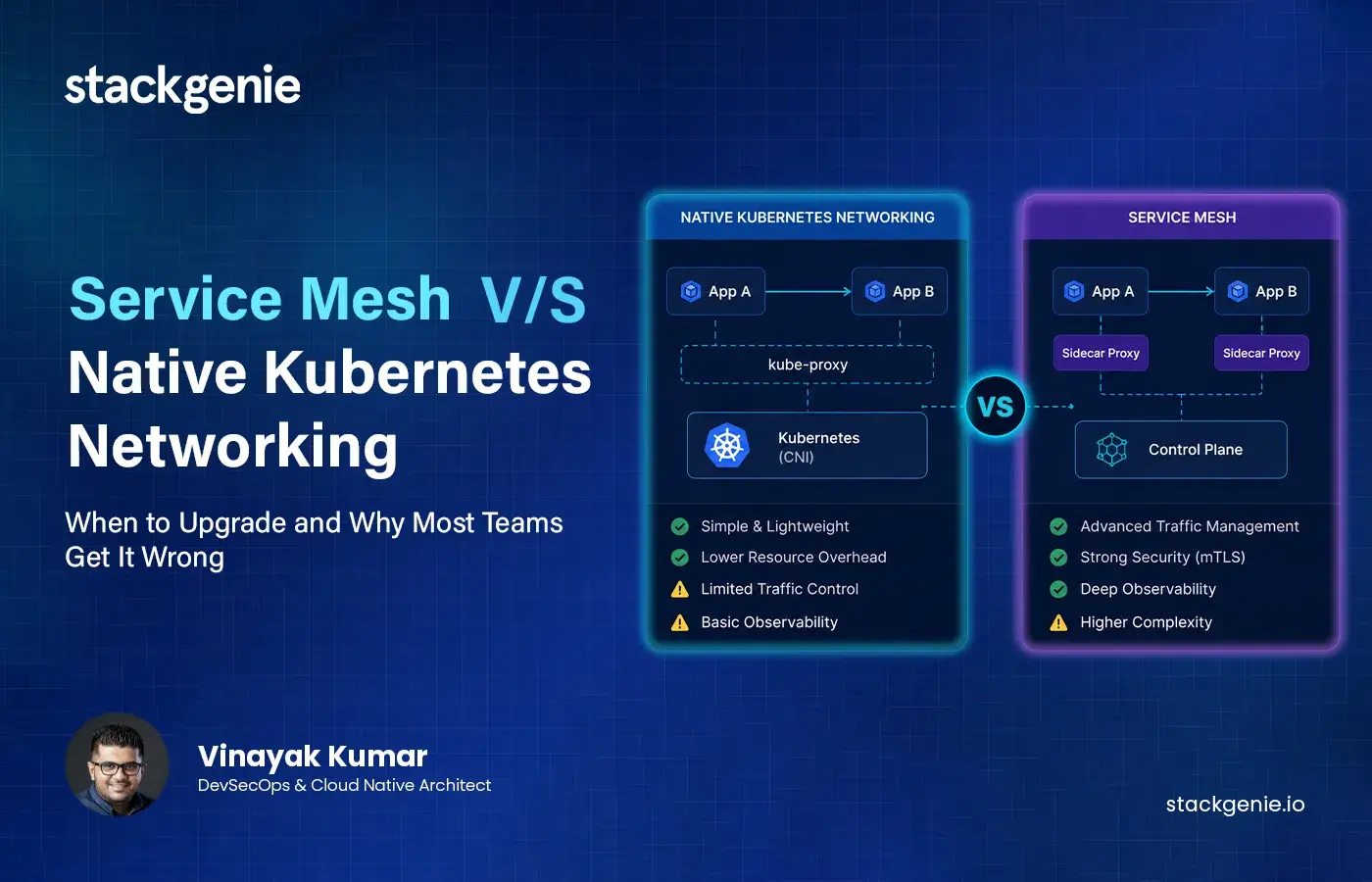
The key insight: Native Kubernetes networking solves the network plumbing problem. It does not solve the traffic management problem.
Where Native Kubernetes Networking Breaks
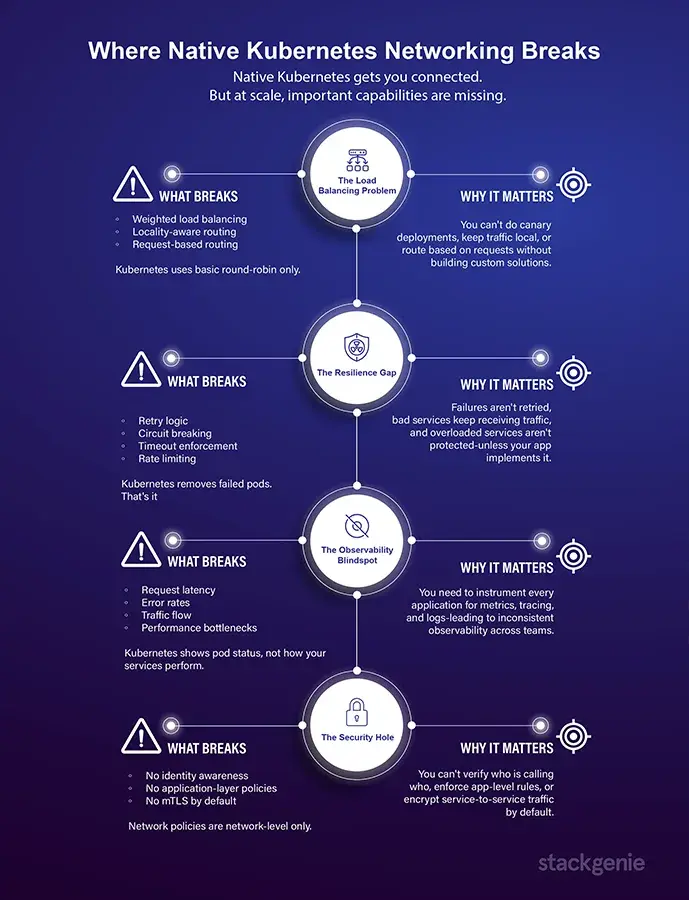
Here’s what I see break consistently when teams scale:
The Load Balancing Problem
Kubernetes services use round-robin load balancing by default. Works fine when all backends are identical. But what about:
- Weighted load balancing: Send 90% of traffic to v1, 10% to v2 (canary deployment)?
- Locality-aware routing: Keep traffic in the same zone to reduce latency?
- Request-based routing: Route requests with header X-User: premium to a different backend?
Native Kubernetes can’t do these. You could write a custom controller, but now you’re building a service mesh from scratch.
The Resilience Gap
When a pod crashes, Kubernetes removes it from the Service. Good. But what about:
- Retry logic: Automatically retry failed requests (with exponential backoff)?
- Circuit breaking: Stop sending traffic to a degrading service?
- Timeout enforcement: Kill requests that hang after 30 seconds?
- Rate limiting: Drop requests when a service gets overwhelmed?
Native Kubernetes doesn’t enforce these. Your application has to. If your app doesn’t implement retries, failed requests are not retried. If it doesn’t implement circuit breakers, cascading failures spread.
The Observability Blindspot
Native Kubernetes shows you pod status. It doesn’t show you:
- Request latency: How fast is service-to-service communication?
- Error rates: What percentage of requests fail between services?
- Traffic flow: Which services are actually calling which?
- Performance bottlenecks: Where is time being spent?
You’d need to instrument every application with tracing, metrics, and logging. Doable, but now you’re asking every team to implement observability independently. Inconsistency follows.
The Security Hole
Network policies are good. But they’re network-level. They say “allow traffic from Pod A to Pod B.”
They don’t say:
- Only allow mTLS: Encrypt all service-to-service traffic?
- Authorization policies: Can Pod A call the GET endpoint but not the DELETE endpoint?
- Fine-grained access control: Can only the billing service call the payments service?
You can technically do this with network policies, RBAC, and certificate management, but you’re gluing together three different systems.
When Native Kubernetes Networking Is Enough
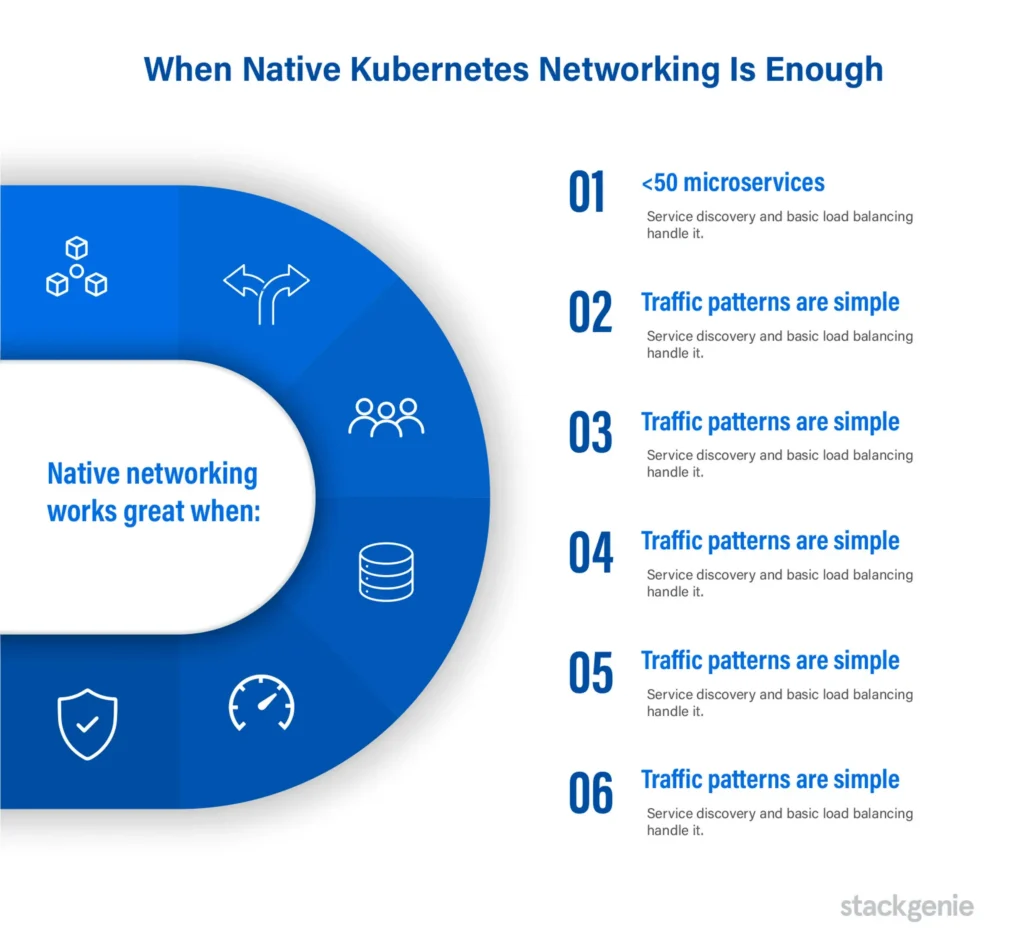
Be honest about your scale. Native networking works perfectly when:
You have <50 microservices: Service discovery and basic load balancing handle it.
Traffic patterns are simple: No canaries, no weighted routing, no advanced traffic splits.
Your teams are small: Coordinating observability implementation across 20 teams is harder than coordinating across 3.
You’re not running stateful workloads: If everything is stateless, locality and connection pooling matter less.
Latency tolerance is high: You don’t need sub-millisecond routing optimization.
Security requirements are basic: Network policies + TLS at the edge are sufficient.
If all of these are true, skip the service mesh. You’ll save operational complexity, resource consumption, and debugging headaches.
When a Service Mesh Becomes Worth It
I call this the “management threshold.” It’s the point at which the operational burden of native networking exceeds that of running a service mesh.
You’ve hit this threshold when:
You’re managing 50+ microservices: Implementing observability, retries, and circuit breaking across 50 independent applications becomes a coordination nightmare. A service mesh centralizes this once.
You need traffic control at scale: Canary deployments, traffic shifting, weighted routing. These should be infrastructure, not application, concerns. A service mesh makes them declarative.
You care about latency: At 100+ microservices, network optimization matters. Locality-aware routing, connection pooling, and HTTP/2: these add up. A service mesh handles them transparently.
Your security posture has tightened: Enforcing mTLS across the entire mesh is simpler than managing TLS certificates for every service pair. Authorization policies become declarative instead of application logic scattered across codebases.
You’re running multiple teams independently: When Team A deploys independently of Team B, they need consistent observability and resilience. A service mesh enforces standards without explicit coordination.
You’re scaling to multiple clusters: If services span multiple Kubernetes clusters or cloud providers, service mesh abstracts away the networking complexity.
The Real Cost: Why Teams Hesitate
To be candid, a service mesh adds operational overhead.
You’ll manage:
- New CRDs: VirtualServices, DestinationRules, AuthorizationPolicies (learning curve)
- Sidecar proxies: Every pod gets an extra container (resource usage, debugging complexity)
- Control plane: Istio’s Istiod or NGINX’s service mesh controller (monitoring, updates, failures)
- Observability tuning: More data flowing through your observability system (costs, complexity)
For teams running <50 microservices, this overhead isn’t justified. The pain of native networking hasn’t hit yet.
For teams running 100+ microservices without a service mesh, the pain is real: scattered retry logic, inconsistent observability, manual canary deployments, and security policies hidden in application code.
Making the Decision: A Checklist
Ask yourself these questions:
1. Are we managing >50 microservices? (Yes = lean toward service mesh)
2. Do we need advanced traffic management? (canaries, weighted routing) (Yes = lean toward service mesh)
3. Is latency a critical metric? (Yes = lean toward service mesh)
4. Do we enforce mTLS everywhere? (Yes = lean toward service mesh)
5. Can our observability team manage a service mesh? (Yes = lean toward service mesh)
6. Do we have the operational bandwidth for a new control plane? (Yes = lean toward service mesh)
If you answered yes to 3 or more: you’re ready.
If you answered yes to fewer than 3: wait 6 months and reassess.
The Honest Middle Ground
Not everything is binary. Some teams run:
- Kubernetes networking for basic routing + service mesh for observability only (disable traffic management, use it for metrics and tracing)
- Lightweight service mesh (NGINX Service Mesh instead of Istio) + native networking for simple cases
- Service mesh in staging, native networking in prod until complexity justifies the upgrade
The worst mistake is over-engineering. Istio in a 10-service cluster is a mistake. Native networking in a 500-service cluster is dangerous.
The Bottom Line
Native Kubernetes networking is a good infrastructure. A service mesh is a better infrastructure at scale.
The question isn’t “which is better.” The question is “at what point does the operational burden of native networking exceed the burden of a service mesh?”
For most teams, that threshold is around 50 microservices, multiple teams, and non-trivial traffic patterns.
Below that threshold, invest in native networking, solid observability, and good deployment practices. You’ll be faster.
Above that threshold, a service mesh pays for itself in reduced operational complexity and faster iteration.
Make the decision based on your actual scale, not on what competitors are doing.
Ready to Evaluate Your Architecture?
Whether you’re scaling native Kubernetes networking or planning a service mesh implementation, the decision should be strategic, not reactive. At StackGenie, we’ve helped enterprises across the US and UK make this call, and more importantly, implement it correctly.
We assess your current architecture, identify the real pain points, and recommend the right path forward. No upsell, no bias. Just honest engineering advice.
Let's talk about your Kubernetes networking and service mesh strategy?
Contact Us NowFrequently Asked Questions
Q1: What is the difference between a service mesh and native Kubernetes networking?
Native Kubernetes networking handles service discovery, basic load balancing, network policies, and ingress routing. A service mesh like Istio or NGINX Service Mesh layers on top to add advanced traffic management (canary deployments, weighted routing), mutual TLS enforcement, circuit breaking, retry logic, and deep per-request observability — none of which Kubernetes provides out of the box.
Q2: When should I use a service mesh instead of native Kubernetes networking?
A service mesh becomes worth the operational overhead when you’re managing 50+ microservices, need canary deployments or weighted routing, require mTLS across all services, have multiple independent teams that need consistent observability, or are running services across multiple clusters or cloud providers.
Q3: Is native Kubernetes networking good enough for most teams?
Yes — for teams running fewer than 50 microservices with straightforward traffic patterns, native Kubernetes networking is fully sufficient. Adding a service mesh below this threshold introduces operational complexity without meaningful benefit.
Q4: What are the downsides of deploying a service mesh?
Every pod gets a sidecar proxy that adds resource overhead, you need to learn and manage new CRDs like VirtualServices and DestinationRules, and you’re responsible for operating a control plane (like Istio’s Istiod). Observability data volume also increases, which adds cost. For small-scale deployments, these costs simply aren’t justified.
Q5: How many microservices do you need before a service mesh makes sense?
The practical threshold is around 50 microservices — especially when combined with multiple teams, non-trivial traffic patterns, or strict security requirements like mTLS. Below that, invest in native networking and solid observability practices instead.
Q6: What does native Kubernetes networking not support?
Native Kubernetes doesn’t support weighted load balancing for canary releases, automatic retries with exponential backoff, circuit breaking, request-level timeouts, rate limiting, mTLS between services, or per-request distributed tracing. Your application code has to handle all of this — which becomes a coordination nightmare at scale.
Q7: Can I use a service mesh just for observability, without enabling traffic management?
Yes. Some teams deploy a service mesh with traffic management features disabled, using it purely for metrics and distributed tracing. This is a legitimate middle ground — you get visibility across all services without taking on the full complexity of traffic policy management.
Q8: Is Istio the right service mesh for every Kubernetes setup?
Not necessarily. Istio is the most feature-complete option but also the most operationally demanding. NGINX Service Mesh and Linkerd are lighter alternatives worth considering if your team’s bandwidth is limited. The right choice depends on your scale, security requirements, and how much operational overhead your team can absorb.


