Inside this article :
Platform engineering promised a lot: faster shipping, happier developers, and infrastructure that just works. When it’s done well, it delivers exactly that a self-service platform that lets developers move fast without wrestling with the underlying complexity.
But platform engineering can also fail quietly. There’s rarely a dramatic outage that announces “your platform isn’t working.” Instead, the signs show up gradually in frustrated developers, mounting tickets, and workarounds that become permanent.
If you’re investing in an internal developer platform, watch for these 5 red flags that your platform engineering is struggling and what to do about each one.
What “Good” Platform Engineering Actually Looks Like
Before the warning signs, it helps to know the target. A healthy platform is self-service, reliable, and genuinely faster than the alternative. Developers reach for it because it’s the easiest path to production not because they’re forced to.
When that’s true, the platform team spends its time improving capabilities, not fielding requests. When it’s not true, the symptoms below start to appear.
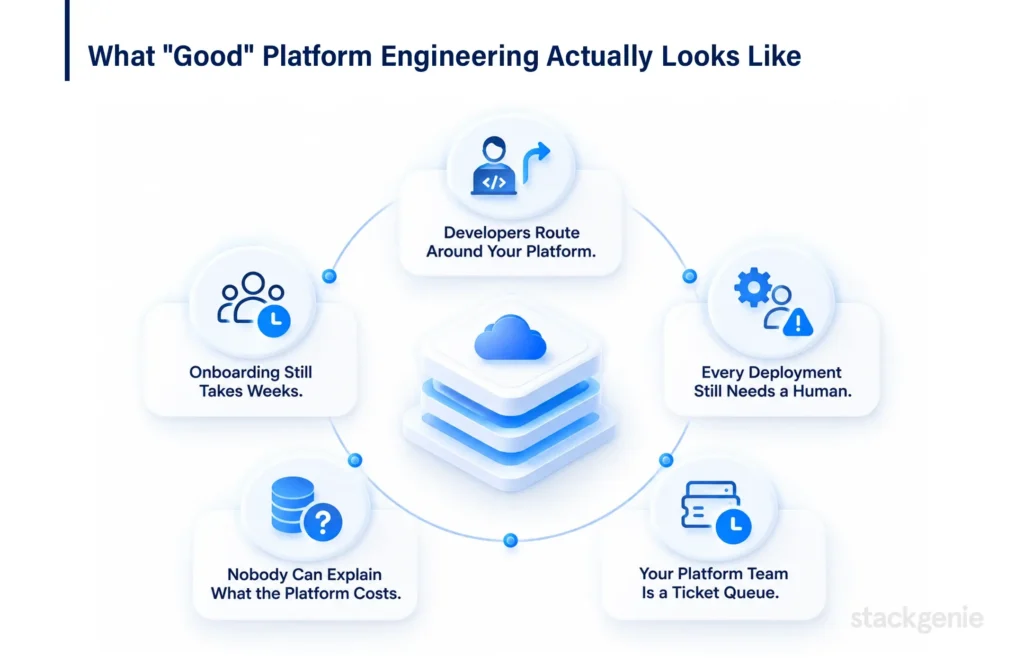 Red Flag #1: Developers Route Around Your Platform
The clearest sign of a struggling platform is that people avoid it. Developers spin up their own scripts, provision resources manually, or maintain “shadow” tooling because the official platform is slower or more painful than doing it themselves.
A platform nobody wants to use isn’t a platform it’s overhead.
When you see workarounds spreading, don’t treat them as bad behavior. Treat them as feedback. Developers route around friction, and every workaround is a map to exactly where your platform is failing them.
Red Flag #2: Every Deployment Still Needs a Human
Self-service is the whole point of platform engineering. If shipping to production still requires a ticket, a Slack message, or a specific person on the platform team to press a button, the platform isn’t doing its job.
Manual gatekeeping doesn’t just slow delivery it creates bottlenecks and single points of failure. When one engineer’s absence stalls every deployment, you’ve built dependency, not enablement.
The fix is designing golden paths: paved, automated routes to production that developers can follow safely on their own.
Stuck between “too manual” and “too risky to automate”? Talk to StackGenie’s platform engineering team we help teams build safe, self-service golden paths that remove humans from the critical path without removing control.
Red Flag #3: Your Platform Team Is a Ticket Queue
Platform teams are supposed to build leverage capabilities that serve every developer at once. When the team instead spends its days on one-off requests, provisioning environments by hand, and answering the same questions repeatedly, something has gone wrong.
A ticket-driven platform team can’t improve the platform, because it’s too busy compensating for the platform’s gaps. This is how promising initiatives stall: the team is working hard, but on the wrong things.
If your platform team’s calendar is full of manual requests, your platform is missing the very features that would eliminate them.
Treat your platform as a product, your developers as customers, and repetitive tickets as a backlog of features waiting to be built.
Red Flag #4: Nobody Can Explain What the Platform Costs
A struggling platform is often an invisible one invisible in reliability, in adoption, and especially in cost. If no one can clearly answer “what does our platform cost to run, and is that number going up or down?”, you’re flying blind.
Uncontrolled infrastructure spend, mystery cloud bills, and resources nobody remembers provisioning are all symptoms of a platform without ownership or visibility. Cost clarity isn’t a finance concern it’s a signal of whether the platform is actually being managed.
The healthiest platforms make cost visible and attributable, so teams can make informed trade-offs instead of discovering surprises at the end of the month.
Red Flag #5: Onboarding Still Takes Weeks
Ask a simple question: how long until a new developer ships their first change to production? If the answer is measured in weeks, your platform isn’t reducing complexity it’s hiding it behind tribal knowledge.
Long onboarding times reveal missing documentation, brittle setup steps, and processes that only a few people fully understand. Every slow onboarding is a preview of the friction your entire team lives with every day.
A strong platform gets new engineers productive in days, not weeks, because the safe path is also the obvious one.
Turn the Red Flags Into a Roadmap
Here’s the encouraging part: every one of these red flags is fixable, and each points directly at what to improve. Workarounds show you where friction lives. Manual deployments show you what to automate. Ticket overload shows you which features to build. Cost blind spots show you where to add visibility. Slow onboarding shows you what to document and streamline.
The teams that succeed with platform engineering aren’t the ones that never hit these problems they’re the ones that recognize the signals early and act on them.
Recognize a few of these red flags in your own organization? Book a platform engineering assessment with Stackgenie we’ll help you turn today’s friction into a clear, prioritized roadmap your team can own long after we’re gone.
StackGenie helps organizations build platforms developers actually love to use and transfers the expertise so your team can carry it forward. Explore our platform and Kubernetes consulting services.
Book a platform engineering assessment with Stackgenie?
Contact Us NowFrequently Asked Questions
Q1. What are the signs that platform engineering is struggling?
Common warning signs include developers bypassing the platform, manual deployment processes, excessive tickets for the platform team, unclear platform costs, and slow developer onboarding.
Q2. Why do developers bypass an internal developer platform?
Developers often bypass a platform when using it is slower or more complicated than manual processes. Workarounds, scripts, and shadow tooling can indicate friction that the platform team needs to identify and address.
Q3. Why are manual deployments a problem for platform engineering?
Manual deployments create bottlenecks, increase dependency on specific team members, and slow software delivery. Effective platform engineering should provide safe, automated golden paths that allow developers to deploy with appropriate controls.
Q4. What does a ticket-driven platform team indicate?
A platform team overwhelmed by repetitive tickets may indicate that the platform lacks self-service capabilities. Repeated requests can be treated as signals for platform features that should be automated or standardized.
Q5. Why should platform engineering teams measure platform costs?
Cost visibility helps organizations understand whether their platform is being managed efficiently. Uncontrolled infrastructure spending and unexplained cloud costs can indicate gaps in ownership, optimization, or resource visibility.
Q6. How does developer onboarding indicate platform engineering maturity?
If new developers need weeks before they can ship their first production change, the platform may still depend heavily on tribal knowledge, manual setup, or incomplete documentation. Mature platforms aim to make the safe path the easiest path.
Q7. What is a golden path in platform engineering?
A golden path is a standardized, automated route that helps developers complete common tasks safely and consistently. Golden paths reduce manual work while preserving the governance and controls required by the organization.
Q8. How can organizations improve a struggling platform engineering strategy?
Organizations can use platform friction as a roadmap: automate manual deployments, convert repetitive tickets into self-service capabilities, improve documentation, increase cost visibility, and streamline developer onboarding.