
Inside this article :
Scale Machine Learning Workloads on Kubernetes the Cost-Efficient Way
The shift from deploying web apps to machine learning models has been one of the most challenging transformations in modern infrastructure. Teams approach MLOps with outdated mindsets.
If you’re running machine learning workloads in 2026, Kubernetes isn’t optional. It separates companies shipping AI features weekly from those debugging scripts at 2 AM. But simply running Kubernetes doesn’t mean you’re doing MLOps correctly.
ML Workloads Break Traditional Infrastructure
Traditional applications are predictable. Your web server needs roughly the same resources on Tuesday and Friday.
Machine learning workflows aren’t predictable.
Data preprocessing hammers CPUs for 20 minutes. Model training demands four GPUs running at full capacity for six hours. Inference serving requires lightweight endpoints that spin up and down unpredictably. Hyperparameter tuning? Dozens of parallel experiments are competing for the same GPU pool.
This isn’t something you can handle with a few autoscaling rules. You need orchestration that understands these workload differences.
Kubernetes solves this through scheduling primitives, resource quotas, and node affinity rules. But configuration matters.
The GPU Scheduling Disaster
Here’s a weekly conversation:
Client: “We’re spending $50,000/month on GPUs, and models still take forever.”
Me: “Show me your Kubernetes configurations.”
What I find: A100 GPUs idle 60% of the time because teams haven’t implemented proper resource sharing, node pool sizing, or priority scheduling.
The fix:
Use node pools strategically. Separate GPU nodes by workload—training gets dedicated pools, inference gets smaller instances with MIG enabled.
Implement priority classes. Production inference should preempt training jobs. Set up Priority Classes to ensure revenue-generating workloads never wait.
Enable cluster autoscaling correctly. Configure separate node pools scaling on pending pod metrics, with different parameters for GPU vs CPU workloads.
Why Vendor Lock-In Kills Innovation
Every cloud provider wants you to believe their managed ML platform is the answer. Solid products—until you’re locked in, paying 3x what Kubernetes costs.
Kubernetes gives you the abstraction layer that matters. Define ML pipelines declaratively, run feature stores in containers, use standard APIs and run the same workload on GCP this quarter and AWS next when pricing shifts.
At StackGenie, we architect ML platforms working identically across clouds. Training runs on Google Cloud’s cheaper GPUs, inference deploys to AWS regional endpoints, and feature storage lives in Azure, where your data warehouse exists.
MLOps Tools That Actually Matter
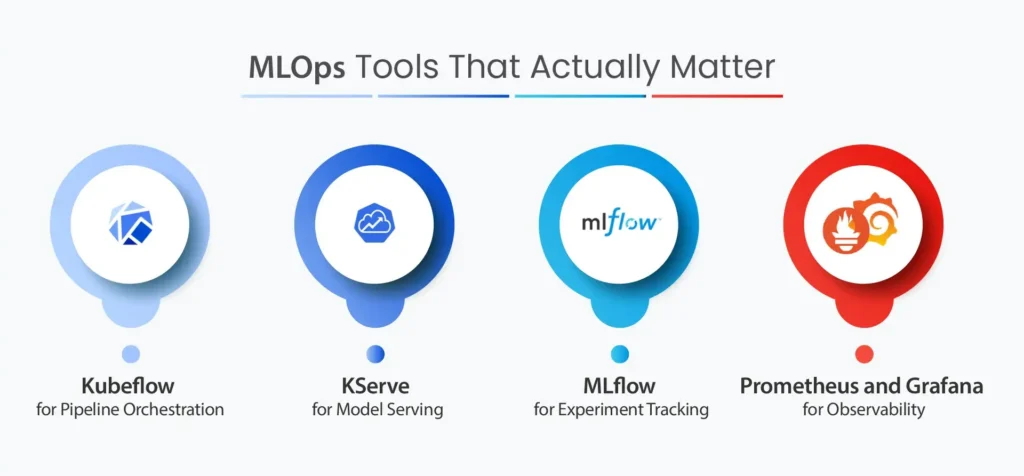
After implementing hundreds of ML platforms, here’s what moves the needle:
Kubeflow for pipeline orchestration. The most mature Kubernetes-native ML platform that doesn’t lock you into vendors.
KServe for model serving. Stop writing custom Flask apps. KServe provides autoscaling, canary deployments, traffic splitting, and monitoring.
MLflow for experiment tracking. Lightweight, works with everything, doesn’t require PhD-level configuration.
Prometheus and Grafana for observability. You need to know when model accuracy degrades, when latency spikes, and when training fails.
Use tools that integrate naturally with Kubernetes. Every custom integration is technical debt.
Day 2 Operations Nobody Prepares For
Getting models into production is easy. Keeping them there that’s where teams fail.
Model drift happens silently. Your credit risk model, working in January, degrades in March. Without automated monitoring, you won’t notice until metrics tank.
Data quality issues compound. One upstream source changes schema, your feature pipeline produces garbage, but your model keeps running.
Resource contention creates failures. A junior data scientist launches 50 hyperparameter jobs, starving production inference. Requests timeout. Revenue drops.
Build operational discipline from day one: automated data validation using Great Expectations, resource quotas at namespace level, drift detection with retraining triggers, and health checks verifying model quality.
The Cost Optimization Nobody Implements
ML infrastructure is expensive. Yet teams treat cost optimization as something for later. That’s backwards.
Use spot instances for training. Training jobs are fault-tolerant—they checkpoint regularly and can resume. Spot instances cut costs 70%.
Implement Karpenter for intelligent bin packing. Karpenter provisions right-sized instances based on pod requirements, consolidates workloads to minimize waste, and automatically selects cost-effective instance types.
Deploy KEDA for event-driven autoscaling. KEDA scales inference endpoints based on queue depth, request rates, or custom metrics—ensuring you only run infrastructure when workload demand exists.
Implement aggressive TTLs for artifacts. That three-month-old experiment? You don’t need its 50GB of checkpoints. Automate cleanup for old artifacts.
Right-size inference endpoints. That model serving 10 requests/second doesn’t need 8 vCPUs and 32GB RAM. Use Horizontal Pod Autoscaling based on actual traffic.
The combination of Karpenter’s bin packing, KEDA’s event-driven scaling, and spot instances helps StackGenie clients reduce costs 40-60% without impacting performance.
Security Gaps Audits Always Find
If ML models train on customer data, you’re facing audits. What auditors find: secrets in plaintext, no RBAC on model access, missing audit trails, lack of data lineage.
The fix: integrate secrets management (Vault, AWS Secrets Manager), implement RBAC, enable audit logging, build data lineage tracking.
This isn’t optional in healthcare, financial services, or regulated industries.
Platform Engineering for ML
Companies create internal ML platforms providing golden paths instead of custom pipelines.
Your ML platform should provide self-service access while enforcing guardrails. Data scientists use templates to handle infrastructure complexity while focusing on models.
MLOps on Kubernetes: What’s Next
AI-powered operations optimize scheduling and predict failures. Edge ML deployment scales using lightweight distributions. LLMOps emerges for large language models.
Why StackGenie for Your MLOps Platform
We’ve spent years building production infrastructure at scale. When ML workloads became critical business systems, we fundamentally rethought how infrastructure should support machine learning pipelines.
At StackGenie, we architect MLOps platforms that solve real problems: GPU utilization that doesn’t waste money, multi-cloud deployments that avoid vendor lock-in, security built in from day one, and operational patterns that scale from 10 to 1,000 models.
We’ve seen what breaks, what scales, what costs millions. More importantly, we’ve built patterns preventing those problems.
If the gap between where you are and where you need to be keeps growing, let’s talk. We’ll help you build an ML platform that’s efficient, reliable, and production-ready.
Because in 2026, companies winning with AI have infrastructure that gets out of the way and lets algorithms run at scale.
Talk to our ML Expert?
Contact Us NowFrequently Asked Questions
1. How do you scale machine learning workloads on Kubernetes?
Machine learning workloads are scaled on Kubernetes using autoscaling, GPU node pools, and orchestration tools like Kubeflow and KServe. Kubernetes dynamically allocates resources based on workload requirements, ensuring efficient scaling for training and inference.
2. Why is Kubernetes important for MLOps?
Kubernetes is essential for MLOps because it provides automation, scalability, and resource management for complex machine learning workflows. It helps manage training jobs, inference services, and pipelines efficiently in production.
3. What is the biggest challenge in running ML workloads on Kubernetes?
The biggest challenge is managing unpredictable resource usage, especially GPU allocation. Without proper scheduling and autoscaling, resources remain underutilized or overloaded, leading to high costs and performance issues
4. How can GPU costs be optimized in Kubernetes?
GPU costs can be optimized by using dedicated node pools, enabling multi-instance GPU (MIG), implementing priority scheduling, and using spot instances for training workloads. Proper autoscaling also reduces idle GPU time.
5. What tools are commonly used for MLOps on Kubernetes?
Common tools include Kubeflow for pipeline orchestration, KServe for model serving, MLflow for experiment tracking, and Prometheus with Grafana for monitoring and observability.
6. How does Kubernetes prevent vendor lock-in for ML workloads?
Kubernetes provides a standardized platform that allows workloads to run across different cloud providers. This enables teams to deploy ML pipelines on AWS, Azure, or Google Cloud without major changes.
7. What is KEDA and how does it help in ML scaling?
KEDA (Kubernetes Event-Driven Autoscaling) helps scale workloads based on real-time events like queue length or request volume. It ensures that inference services scale only when needed, reducing infrastructure costs.
8. What is Karpenter and why is it important?
Karpenter is a Kubernetes autoscaler that provisions optimal compute resources based on workload needs. It improves cost efficiency by selecting the right instance types and minimizing unused capacity.
9. What is model drift and how do you handle it?
Model drift occurs when a model’s performance degrades over time due to changes in data. It is handled by continuous monitoring, data validation, and automated retraining pipelines.
10. Is Kubernetes necessary for machine learning in 2026?
Yes, Kubernetes has become a standard for managing production-grade ML workloads. It provides the scalability, flexibility, and automation required for modern AI systems.