

Inside this article :
Introduction
Prometheus, Kubecost, and CloudZero solve different aspects of Kubernetes cost management. Prometheus collects infrastructure metrics, Kubecost translates Kubernetes resource usage into workload-level cost insights, and CloudZero delivers multi-cloud cost intelligence with advanced analytics. The best choice depends on whether your priority is metrics, Kubernetes cost allocation, or enterprise-wide cloud financial management.
I’ve worked with hundreds of teams managing Kubernetes at scale, and I’ve noticed a pattern: they spend months optimizing their infrastructure, then measure the results with nothing better than an AWS bill PDF they download once a month. It’s like flying a plane with no instruments.
Cost monitoring isn’t optional. Without visibility into what’s actually costing money, optimization is guesswork. This guide walks through the real options for Kubernetes cost monitoring and helps you choose the right tool for your team and scale.
The Cost Visibility Problem
Here’s what most enterprises know about their Kubernetes costs:
- Total monthly cloud bill (from AWS, GCP, or Azure)
- Approximate number of clusters
- Rough compute cost vs. storage cost split
Here’s what they should know:
- Cost per service, team, or business unit
- Which workloads are consuming resources inefficiently
- Reserved instance utilization rates and wasted capacity
- Cost trends, anomalies, and optimization opportunities
- Attribution: Is this spike from a test environment or production?
The gap between “total bill” and “cost per workload” is where most teams fail. Without it, you’re managing costs across the entire infrastructure rather than pushing accountability to the teams that control it.
Prometheus: The Infrastructure Monitoring Foundation
Prometheus is the default metrics collection tool in Kubernetes environments. It scrapes metrics from nodes, pods, and services every 15-30 seconds, storing a dense time-series database of performance and resource data.
What Prometheus Does Well:
Prometheus gives you the raw material for cost analysis. It tracks CPU, memory, and storage usage at granular levels—per node, per pod, per namespace. If you run Prometheus, you have the underlying data to calculate costs.
The Prometheus ecosystem also includes tools such as Node Exporter (hardware metrics) and kube-state-metrics (Kubernetes object metrics) that automatically populate this data. For teams already running Prometheus for alerting and performance monitoring, it feels natural to extend it into cost tracking.
The Catch:
Raw metrics aren’t costs. Knowing a pod used 2 vCPU-hours doesn’t tell you what you paid for it. You have to map that usage to actual cloud pricing, account for reserved instances, spot instance discounts, and multi-region pricing variations—all of which change monthly.
Prometheus alone is a foundation, not a solution. Teams that try to do cost accounting purely on Prometheus metrics end up maintaining hundreds of custom Prometheus queries and rules, most of which become stale within months.
Best for: Teams where cost tracking is a secondary use case and you already own Prometheus infrastructure. Not recommended as a primary cost monitoring solution.
Kubecost: Kubernetes-Native Cost Intelligence
Kubecost is purpose-built for Kubernetes cost allocation. It consumes metrics from Prometheus, cloud provider APIs, and your billing data to answer the question teams actually care about: “What did this workload cost?”
What Kubecost Does Well:
Kubecost allocates costs to Kubernetes objects—namespaces, deployments, labels, or any custom cost grouping you define. This is powerful for teams using Kubernetes as a multi-tenant infrastructure. You can charge back to individual teams, projects, or business units with real precision.
It also integrates seamlessly with Kubernetes workflows. Custom resource definitions for AlertRules, Savings Policies, and Cost Allocation let you embed cost management into your infrastructure-as-code. If you’re already thinking in Kubernetes resources, Kubecost feels native.
Kubecost also provides real-time savings recommendations—”You could save $4,000/month by rightsizing this deployment” or “This cluster is 40% underutilized.” These aren’t generic; they’re based on your actual usage patterns.
The Tradeoffs:
Kubecost requires Prometheus to be running (it’s a dependency, not optional). You’re also dependent on Kubecost’s cost calculation logic, which approximates pricing from some cloud providers. If you need perfect billing reconciliation, you’ll still need to cross-check against actual invoices.
Also, Kubecost is best for single-cloud deployments. If you’re running Kubernetes on AWS, GCP, and Azure simultaneously, Kubecost works but requires separate instances per cloud, with no unified dashboard across clouds.
Cost-wise, Kubecost has free and paid tiers. The free tier is surprisingly capable—good enough for most teams with annual cloud spend under $500K.
Best for: Kubernetes-first organizations where cost accountability by team/project is a priority, and your infrastructure is primarily single-cloud.
CloudZero: Cross-Cloud Cost Intelligence for Enterprise
CloudZero takes a different approach. Instead of Kubernetes-specific allocation, it connects directly to your cloud provider billing APIs (AWS Cost Explorer, GCP Billing, Azure Cost Management). It applies AI-driven analysis to understand what’s actually driving your bills.
What CloudZero Does Well:
CloudZero excels at root-cause analysis. Most cost monitoring tools show you what something costs. CloudZero helps you understand why it costs that much and what’s driving anomalies.
For enterprises with multi-cloud infrastructure, CloudZero’s unified dashboard is genuinely valuable. You can see costs across AWS, GCP, and Azure in a single interface. You can tag infrastructure consistently across all three clouds to achieve consistent cost allocation.
CloudZero’s AI engine also automatically identifies optimization opportunities. Rightsizing recommendations, commitment utilization analysis, and anomaly detection run continuously without manual tuning.
The Tradeoffs:
CloudZero doesn’t give you Kubernetes-level granularity out of the box. It’s better at cloud-level analysis (EC2 cost trends, storage optimization, commitment utilization) than at pod-level allocation. If you need to charge back compute costs to individual development teams, Kubecost is more precise.
CloudZero is also positioned for the enterprise, with pricing starting at $2,000- $ 5,000/month. For smaller organizations or cost-conscious teams, the investment might not justify the benefits.
Best for: Multi-cloud enterprises where unified visibility across AWS, GCP, and Azure is essential, and you have the budget for comprehensive cost intelligence.
Comparing the Three: A Decision Matrix
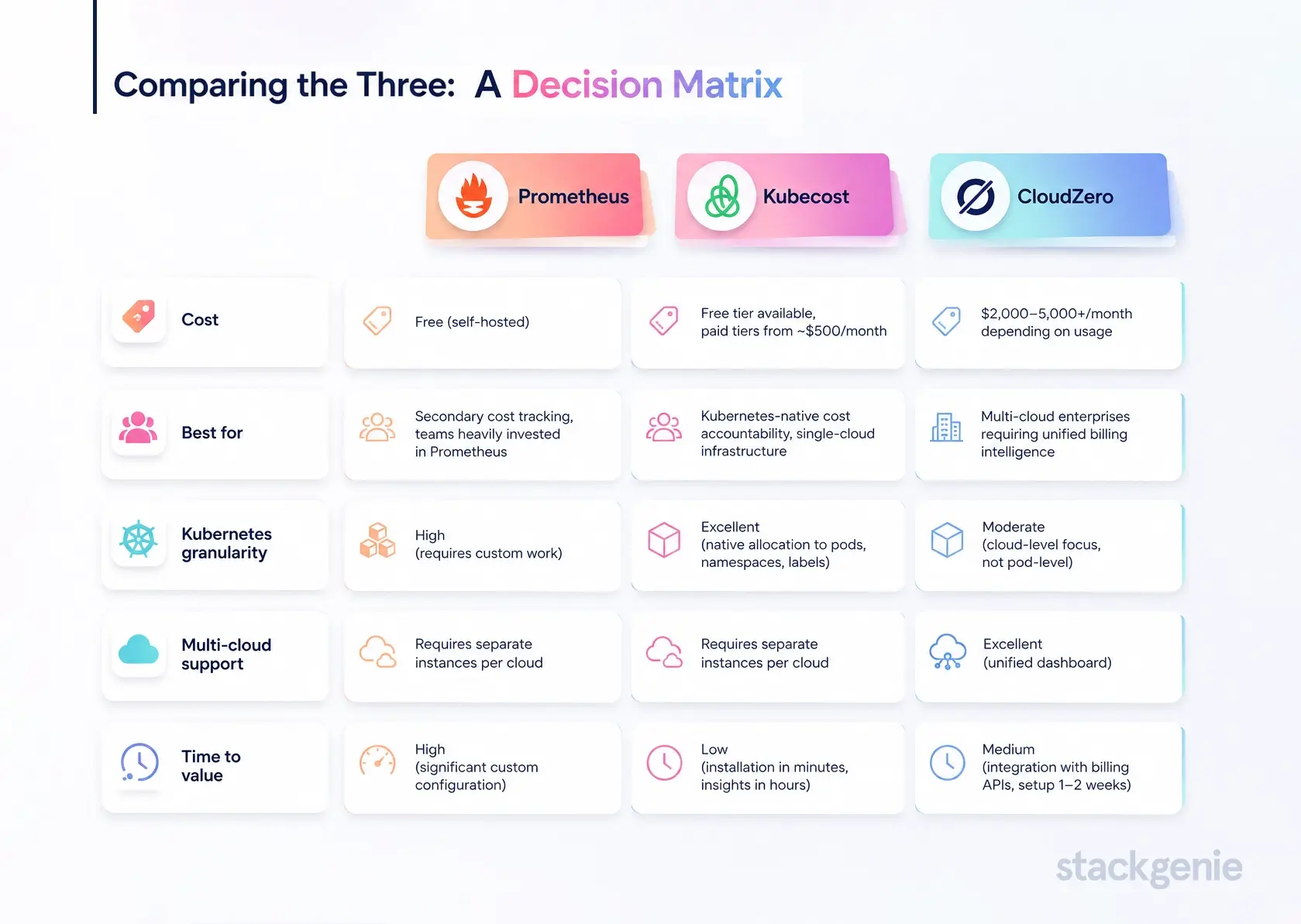 Prometheus
- Cost: Free (self-hosted)
- Best for: Secondary cost tracking, teams heavily invested in Prometheus
- Kubernetes granularity: High (requires custom work)
- Multi-cloud support: Requires separate instances per cloud
- Time to value: High (significant custom configuration)
Kubecost
- Cost: Free tier available, paid tiers from ~$500/month
- Best for: Kubernetes-native cost accountability, single-cloud infrastructure
- Kubernetes granularity: Excellent (native allocation to pods, namespaces, labels)
- Multi-cloud support: Requires separate instances per cloud
- Time to value: Low (installation in minutes, insights in hours)
CloudZero
- Cost: $2,000-5,000+/month depending on usage
- Best for: Multi-cloud enterprises requiring unified billing intelligence
- Kubernetes granularity: Moderate (cloud-level focus, not pod-level)
- Multi-cloud support: Excellent (unified dashboard)
- Time to value: Medium (integration with billing APIs, setup 1-2 weeks)
The Real-World Scenario
You’re a Series B company running Kubernetes on AWS and GCP. Development teams are charged back based on their namespace costs. You also need unified visibility for executives.
The answer: Kubecost for Kubernetes-level allocation (one instance per cloud) + CloudZero for cross-cloud unified reporting and anomaly detection. Together, they cover both the granular accountability Kubecost excels at and the multi-cloud intelligence CloudZero provides.
Cost: ~$500/month (Kubecost) + $3,000/month (CloudZero) = $3,500/month for comprehensive cost intelligence. If this surfaces $10,000+ in optimization opportunities monthly, it’s a sub-4-month ROI investment.
The Implementation Reality
Choosing the tool is the easy part. The hard part is operational discipline: setting up accurate tagging, establishing cost-allocation rules that align with your organizational structure, and actually acting on the insights the tool generates.
A well-configured Kubecost that nobody uses is worth zero. A CloudZero dashboard that nobody checks is an expensive status symbol.
The best cost monitoring is the one your team uses consistently. Start with whichever tool aligns with your cloud strategy, implement it thoroughly, and then layer in additional tools as you grow.
Getting Started
If you’re not currently monitoring Kubernetes costs at this level of detail, you’re leaving significant optimization on the table. Start with a single tool—Kubecost if you’re single-cloud, CloudZero if you’re multi-cloud—and commit to 90 days of measurement and experimentation.
Most teams discover 25-40% cost optimization opportunities within the first month of detailed visibility.
If your team needs help designing a cost monitoring strategy tailored to your multi-cloud infrastructure, evaluating these tools, or building the operational discipline to act on cost insights, connect with our cloud cost and platform engineering specialists. We’ve helped enterprises implement cost monitoring that drives actual infrastructure changes and accountability.
Talk to our cloud cost and platform engineering specialists?
Contact Us NowFrequently Asked Questions
Q1. What is Kubernetes cost monitoring?
Kubernetes cost monitoring is the process of tracking, allocating, and optimizing cloud infrastructure costs across Kubernetes clusters, workloads, namespaces, and teams.
Q2. What is Kubecost?
Kubecost is a Kubernetes-native cost monitoring platform that maps cloud spending to workloads, namespaces, deployments, and business units while providing optimization recommendations.
Q3. Is Prometheus a cost monitoring tool?
No. Prometheus is an infrastructure monitoring solution that collects resource metrics. It does not calculate cloud costs without additional tooling.
Q4. What is CloudZero?
CloudZero is a cloud cost intelligence platform that analyzes cloud billing data across AWS, Azure, and Google Cloud to identify spending trends and optimization opportunities.
Q5. Which Kubernetes cost monitoring tool should I choose?
Organizations focused on Kubernetes cost allocation often choose Kubecost, while enterprises requiring cross-cloud financial visibility may prefer CloudZero. Prometheus is typically used as the metrics foundation rather than a standalone cost solution.