

Inside this article :
If you’re managing cloud infrastructure in 2026, you’ve noticed the automation tools meant to make your life easier are eating up your budget. Enterprise technology leaders everywhere are grappling with this reality. DevOps automation frameworks have become cost centers instead of competitive advantages.
DevOps Managed Services offer a way to offload the operational complexity of CI/CD pipelines, Kubernetes orchestration, and multi-cloud governance while maintaining the delivery speed your business demands. The shift is structural, not tactical. With senior DevOps engineers commanding $200+ per hour and platform engineering talent becoming increasingly scarce, the traditional “build it all in-house” approach is forcing companies to reconsider their infrastructure strategy fundamentally.
What DevOps Managed Services Actually Do
DevOps Managed Services aren’t just glorified hosting providers. They embed directly into your software delivery lifecycle, taking operational responsibility for the automation frameworks that move code from development to production.
Quality providers start with an infrastructure audit, map your current CI/CD pipelines, identify where configuration drift occurs across environments, and quantify the cost of manual intervention in deployment workflows. Then they implement Infrastructure as Code workflows using tools like Terraform or Pulumi, establishing declarative configuration patterns that eliminate the “snowflake server” problem where every environment has unique, undocumented quirks that break when you scale.
Here’s a practical example of how this works with Kubernetes cluster management. Providers set up GitOps-based deployment patterns in which all cluster configuration lives in version-controlled repositories, with Argo CD or FluxCD as the reconciliation engine. When developers commit application manifests or Helm charts, automated pipelines trigger security scans for container vulnerabilities, run policy checks against organizational guardrails (defined in the Open Policy Agent), and detect drift between the desired state and the actual cluster configuration.
Managed service teams monitor these pipelines 24/7, responding to failed deployments through automated rollback mechanisms while routing complex issues through proper escalation paths. Cost monitoring gets smart: automated alerts fire when resource consumption deviates from established baselines. If a microservice suddenly requests 400% more memory than historical averages, you get an immediate notification. Whether it’s a memory leak or an unexpected traffic surge, you catch it before it hits your monthly bill.
DevSecOps practices embedded within DevOps Managed Services shift vulnerability detection left in your development cycle, scanning container images and infrastructure code before they reach production environments. Critical vulnerabilities trigger immediate pipeline failures, blocking deployments until patches are applied. Lower-severity issues generate tickets with full context, including the vulnerability, affected services, and recommended fixes. Compliance guardrails enforce requirements such as GDPR data residency or HIPAA encryption through policy-as-code frameworks, without manual review gates that slow delivery velocity.
Why Companies Choose DevOps Managed Services: The Talent Problem
Let’s address the elephant in the room: finding and retaining DevOps talent in 2026 is brutally expensive and time-consuming.
Building an in-house platform engineering team capable of managing modern DevOps toolchains requires specialists in Kubernetes cluster management, CI/CD orchestration, observability frameworks, security automation, and cloud cost optimization. These aren’t skills that typically coexist in individual engineers, and when you assemble a team with this expertise, you’re looking at serious compensation. Senior Site Reliability Engineers earn $180,000 to $250,000 in total compensation for US-based roles, with hiring timelines extending six months from requisition to productive output.
Managed service providers address this gap through economies of scale, spreading specialist expertise across multiple client engagements while maintaining 24/7 operational coverage that would require significant headcount for individual organizations to replicate. Running 50 production Kubernetes clusters might cost $500,000 annually, building and retaining an internal team with sufficient depth to handle cluster upgrades, security patches, cost optimization, and incident response. Comparable managed service engagements typically run $120,000 to $200,000 annually while providing immediate access to specialists who’ve operationalized similar patterns across dozens of implementations.
The knowledge transfer dimension proves equally valuable. Managed service engagements expose internal teams to operational patterns they’d otherwise develop through trial and error, addressing the platform engineering maturity gap: organizations understand conceptually that they need internal developer platforms but lack operational experience to build self-service infrastructure that balances developer velocity with appropriate security and cost guardrails.
Where DevOps Managed Services Are Headed
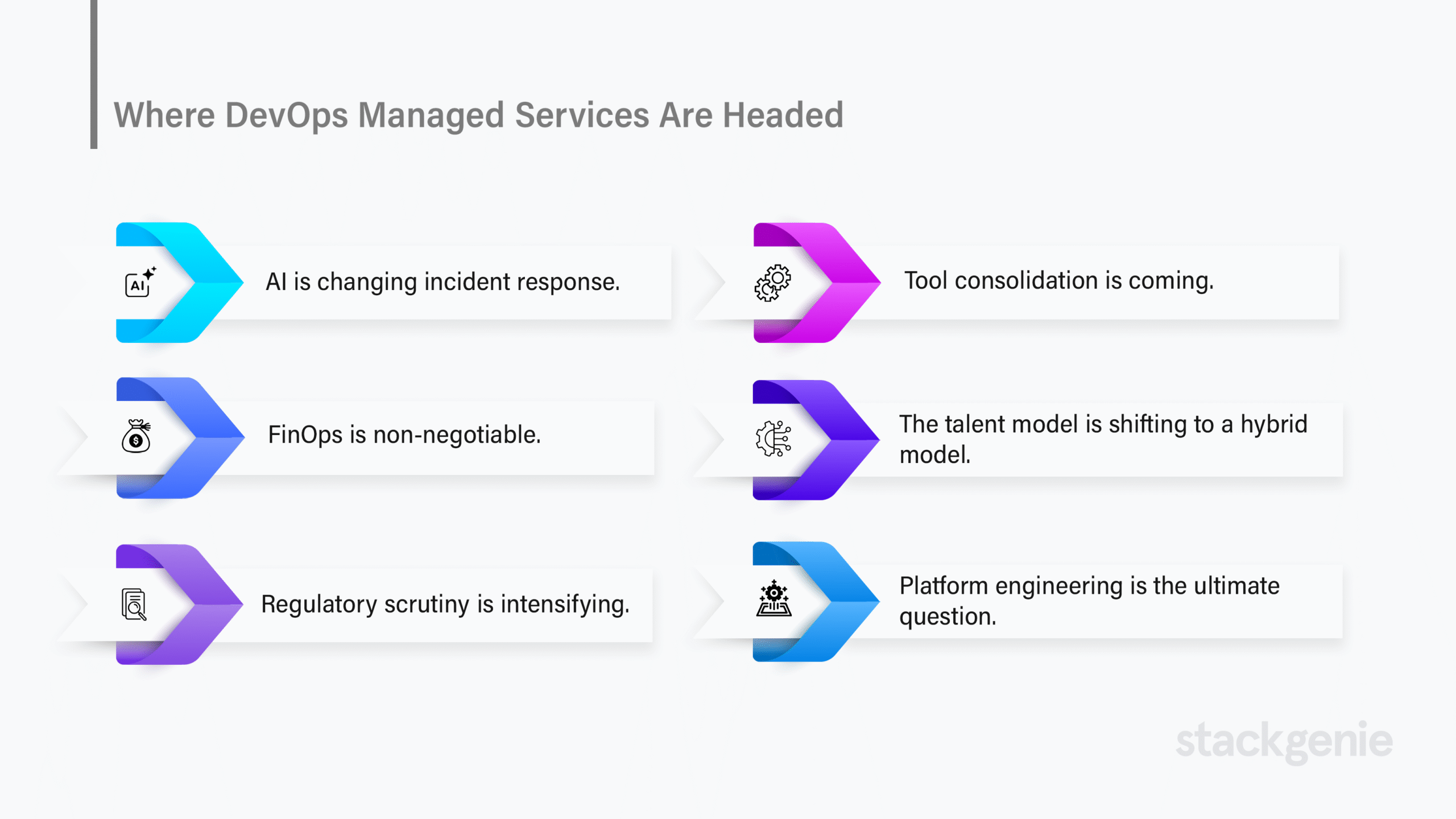 AI is changing incident response: Machine learning models trained on historical incident data automatically classify alerts, predict root causes, and recommend fixes, cutting mean time to recovery from hours to minutes. Providers embed AI agents that analyze log patterns, correlate events across distributed systems, and generate runbooks for complex failure scenarios.
FinOps is non-negotiable: Modern services integrate cost management directly into workflows, and every infrastructure change includes projected monthly cost impact and right-sizing recommendations. Providers implementing automated cost anomaly detection find 30-40% savings in orphaned resources, oversized instances, and inefficient data transfer patterns.
Regulatory scrutiny is intensifying: Financial services regulators require detailed audit trails showing who made what changes and when. Providers must deliver immutable audit logs, change approval workflows, and compliance attestations.
Tool consolidation is coming: Organizations recognize that having 15 different DevOps tools creates an “integration tax” that erodes productivity. The strategic question: standardize on comprehensive platforms like GitLab or Azure DevOps, or maintain best-of-breed tools orchestrated through managed service expertise? Enterprise DevOps toolchain licenses regularly exceed $100,000 annually for mid-sized companies.
The talent model is shifting to a hybrid model: Smart organizations keep architectural oversight in-house while outsourcing operational execution. This requires clarity about where your team ends and the external team begins for security escalations, capacity planning, and tool selection.
Platform engineering is the ultimate question: As DevOps practices mature, you’ll want internal developer platforms. Do DevOps Managed Services accelerate or slow this journey? The answer depends on the contract structure. Engagements designed for knowledge transfer help teams absorb operational patterns and gradually take over. Purely operational engagements can create dependency, delaying internal capability development.
At StackGenie, we build DevOps Managed Services to accelerate your platform engineering maturity, not create dependency. We embed with your team, transfer knowledge continuously, and design engagements to make ourselves less necessary as your capabilities grow. The goal isn’t just managing infrastructure, it’s helping you build operational excellence that becomes your competitive advantage.
Talk to our DevOps Expert?
Contact Us NowFrequently Asked Questions
1. What are DevOps Managed Services?
DevOps Managed Services provide outsourced management of CI/CD pipelines, Kubernetes clusters, cloud governance, and automation workflows.
2. How do DevOps Managed Services reduce cloud costs?
They implement Infrastructure as Code, right-size workloads, eliminate resource waste, and integrate FinOps monitoring into deployment pipelines.
3. Are DevOps Managed Services cheaper than hiring in-house?
For many enterprises, managed services cost 40–60% less than building and retaining a full internal DevOps team.
4. Do DevOps Managed Services include security?
Yes. Most providers embed DevSecOps practices, container scanning, compliance automation, and policy-as-code enforcement.
5. How do DevOps Managed Services support platform engineering?
They help design internal developer platforms with governance guardrails while enabling knowledge transfer to internal teams


