
Inside this article :
In early 2026, GitOps has evolved from an emerging practice to the de facto standard for managing cloud-native infrastructure. According to the latest CNCF survey, 96% of organizations are now using or evaluating GitOps in production. Yet many companies struggle to implement it effectively, turning potential velocity gains into deployment bottlenecks.
After two decades in DevOps and helping hundreds of companies navigate this transformation, I’ve seen the pattern: teams that succeed with GitOps don’t just install tools. They partner with experienced consultants who understand the nuances of multi-cluster architectures, AI workload scheduling, and zero-trust security models that define 2026’s infrastructure landscape.
Why GitOps Consulting Matters More Than Ever
GitOps consulting in 2026 addresses challenges that didn’t exist even a year ago. With Kubernetes 1.35’s GPU scheduling capabilities for AI/ML workloads, edge computing deployments, and increasingly sophisticated supply chain attacks, the complexity has multiplied exponentially.
Modern GitOps consulting isn’t about installing Argo CD or FluxCD anymore. It’s about architecting systems that handle AI model serving, serverless containers, multi-cloud deployments, and compliance requirements simultaneously, while maintaining developer velocity.
Companies implementing GitOps properly see deployment frequency increase 60%, configuration drift approach zero, and mean time to recovery drop to minutes. But DIY implementations often fail within six months due to poor repository structure, inadequate secrets management, or security gaps that expose entire clusters.
What Elite GitOps Consulting Delivers in 2026

Strategic Architecture for Modern Workloads Today’s consultants design GitOps architectures that handle traditional applications alongside AI workloads requiring GPU allocation, edge deployments with intermittent connectivity, and serverless functions all managed declaratively through Git.
AI-Enhanced Automation Leading consulting firms now leverage AI-assisted GitOps tools that can propose infrastructure changes from natural language requests while enforcing policy-as-code and maintaining full audit trails. This combines automation speed with governance rigor.
Zero-Trust Security Integration GitOps security in 2026 goes beyond secrets management. Consultants implement supply chain security with signed commits, SBOM generation, runtime policy enforcement with OPA or Kyverno, and integration with zero-trust frameworks that treat every deployment as potentially compromised.
Multi-Cluster Federation at Scale Most enterprises now run dozens of clusters across regions and clouds. Expert consultants design promotion workflows, environment parity, and disaster recovery strategies that work seamlessly whether you’re managing 5 or 500 clusters.
Platform Engineering Enablement The best GitOps implementations create internal developer platforms where engineers self-serve infrastructure through pull requests, with automated guardrails preventing configuration drift, cost overruns, and security violations.
The StackGenie Approach to GitOps Consulting
We at StackGenie, we have refined our GitOps methodology to address 2026’s realities: AI workloads, edge computing, regulatory complexity, and the shift toward platform engineering.
Business-Outcome Focused We start by understanding your actual objectives: accelerating AI model deployment, achieving SOC 2 compliance, enabling developer self-service, or reducing cloud costs. These goals shape every technical decision from tool selection to repository structure.
Incremental Transformation We don’t rip and replace. We identify a strategic pilot project, prove value within weeks, then systematically expand. This approach minimizes risk while building organizational confidence and expertise.
Embedded Knowledge Transfer Our consultants pair-program with your team, conduct architecture reviews together, and respond to incidents collaboratively. Knowledge transfer happens organically through shared problem-solving, not PowerPoint decks.
Day-Two Operations Focus The real test of GitOps success is whether your team operates independently six months later. We design for operational sustainability, not consulting dependency.
Modern GitOps Technology Stack
The 2026 GitOps ecosystem is mature and specialized:
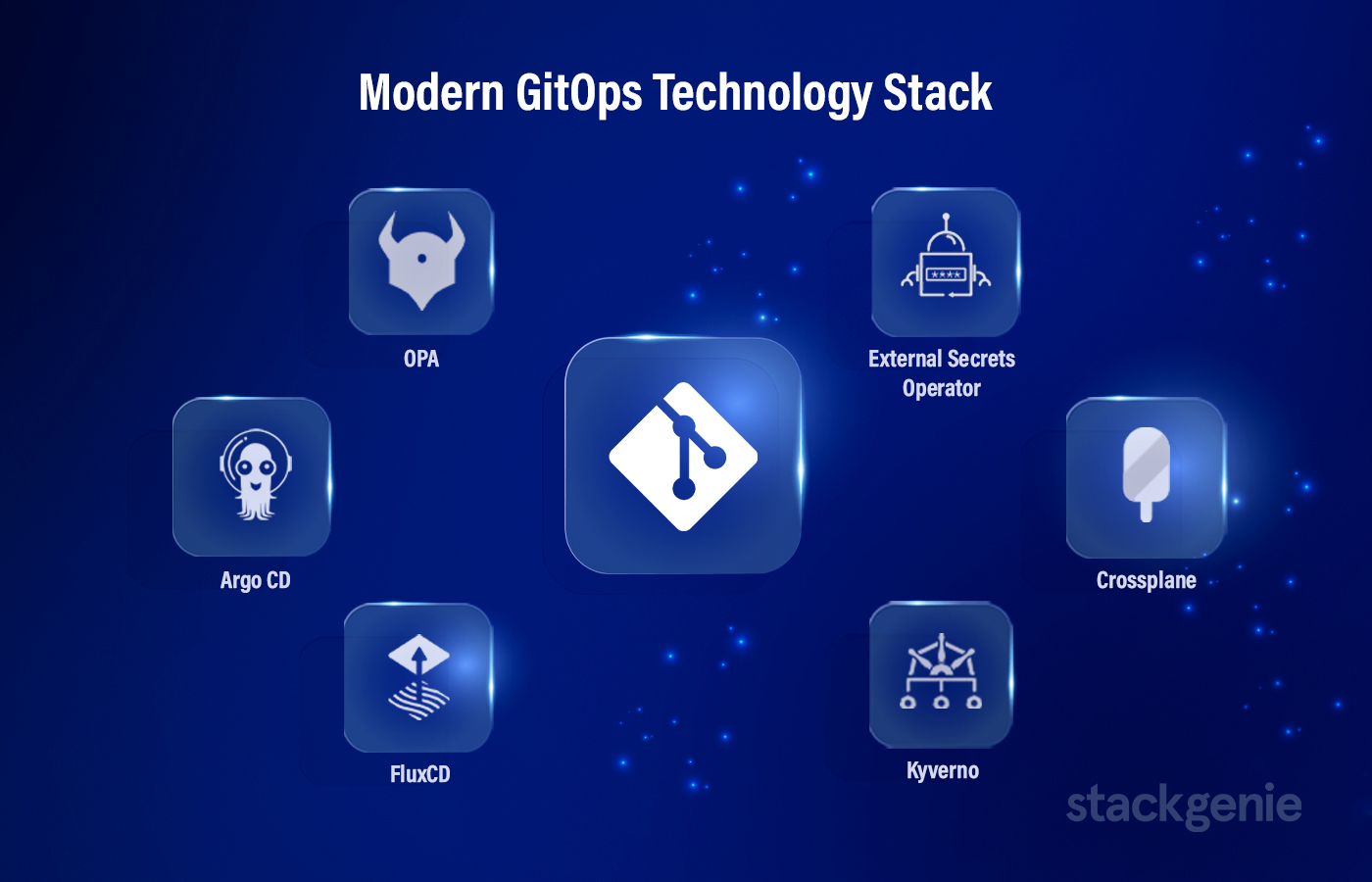
Argo CD remains the most popular choice with enhanced multi-tenancy, progressive delivery capabilities, and AI-assisted rollout strategies. Best for teams wanting centralized control and rich UI visibility.
FluxCD has evolved with modular components perfect for complex multi-cluster scenarios, OCI registry support, and deep customization. Ideal when you need flexible, decentralized architectures.
Crossplane has emerged for infrastructure-as-code scenarios, enabling Kubernetes-style APIs for provisioning cloud resources declaratively.
External Secrets Operator and SOPS handle secrets management without storing sensitive data in Git, integrating with Vault, AWS Secrets Manager, and cloud KMS services.
Policy-as-Code tools like OPA and Kyverno enforce compliance automatically, preventing misconfigurations before they reach production.
The right consultant isn’t dogmatic about tools. They select based on your team’s capabilities, existing investments, and specific requirements.
Measuring Real GitOps Success
Track these metrics to validate your GitOps investment:
Deployment Frequency: Should enable multiple daily releases
Lead Time for Changes: Commit to production in minutes, not hours
MTTR: Git-based rollbacks enable sub-5-minute recovery
Configuration Drift: Should approach zero with automated reconciliation
Developer Velocity: Engineers ship features instead of fighting deployments
Cost Efficiency: Proper resource scheduling can reduce cloud spend 30%+
Elite consultants establish baselines before implementation and demonstrate measurable improvements throughout.
Overcoming Common GitOps Challenges
AI/ML Workload Complexity Modern consultants understand GPU scheduling, model versioning, and the unique challenges of deploying AI workloads declaratively.
Edge Computing Integration Managing hundreds of edge locations with intermittent connectivity requires specialized GitOps patterns that most teams haven’t encountered.
Regulatory Compliance From GDPR to SOC 2 to industry-specific requirements, consultants design audit trails, immutable infrastructure, and policy enforcement that satisfy compliance teams.
Legacy System Integration Not everything fits GitOps perfectly. Experienced consultants create hybrid approaches for brownfield environments while maintaining the benefits of declarative management.
Why Choose StackGenie for GitOps Consulting
When evaluating GitOps consulting partners in 2026, demand:
Production Battle Scars: Real experience managing GitOps at scale across AI workloads, edge computing, and multi-cloud environments, not just lab demos.
Security Expertise: Deep understanding of supply chain security, zero-trust architectures, and compliance frameworks.
Platform Engineering Mindset: Ability to build internal developer platforms that empower teams while maintaining governance.
Tool-Agnostic Guidance: Recommendations based on your context, not vendor certifications.
Sustainability Focus: Consultants who enable independence, not dependency.
StackGenie brings 20+ years of DevOps expertise to every engagement, helping companies from venture-backed startups to Fortune 500 enterprises implement production-grade GitOps that scales.
The ROI of Professional GitOps Consulting
A typical mid-market company investing $100,000-150,000 in comprehensive GitOps consulting sees ROI within 6-9 months through:
- Developer productivity gains (40% faster deployment cycles)
- Reduced incident frequency (60% fewer configuration-related outages)
- Cloud cost optimization (20-30% savings from better resource utilization)
- Compliance efficiency (automated audit trails eliminate manual documentation)
- Competitive advantage (shipping features weeks faster than competitors)
The alternative continuing with manual deployments, configuration drift, and deployment anxiety becomes existentially dangerous as competitors leverage GitOps for velocity.
Ready to Transform Your Infrastructure?
GitOps consulting isn’t about following trends. It’s about building competitive advantage through reliable, scalable, auditable infrastructure that empowers your team and accelerates your business.
If you’re struggling with deployment complexity, preparing for AI/ML workload management, facing compliance requirements, or planning rapid scaling, professional GitOps consulting delivers results that DIY approaches cannot match.
StackGenie specializes in GitOps transformation for the 2026 landscape from AI workload orchestration to edge computing to zero-trust security. We’ve guided hundreds of implementations and can design a customized approach for your specific challenges, timeline, and budget.
Talk to our GitOps Expert?
Contact Us NowFrequently Asked Questions
1. What is GitOps consulting?
GitOps consulting helps organizations implement Git-based automation for Kubernetes deployments, infrastructure management, and compliance enforcement.
2. Why is GitOps important for Kubernetes scaling?
GitOps enables automated reconciliation, version-controlled infrastructure, and policy enforcement, making it easier to manage multi-cluster Kubernetes environments.
3. What tools are used in GitOps consulting?
Common tools include Argo CD, FluxCD, Crossplane, OPA, Kyverno, and External Secrets Operator.
4. How does GitOps improve security?
GitOps enhances security through signed commits, policy-as-code enforcement, secrets encryption, and zero-trust deployment models.
5. How long does a GitOps implementation take?
Most organizations see measurable results within 6–12 weeks depending on complexity.