

Policy and Governance in Kubernetes:
In brief, policy and governance provide a set of rules which define a guideline that either can be enforced or audited. In the kubernetes ecosystem the governance model plays a crucial role in managing and organising the infrastructure, security and consistency of the resources and deployments. Kubernetes provides Role-based Access Control (RBAC) which is an authorization mechanism for creating and managing permission around Kubernetes resources. But RBAC doesn’t allow admins to control the specification of the kubernetes resources. By controlling these specifications could help the administrators to be able to define the policy boundaries and limits.
These limitations could be overcome by using Kubernetes native Policy management and Governance tools. Advantages of using these policy and governance tools:
- Restrict running pods as the root user
- Required labels to group resources
- Provide resource requests and limits
- Whitelisting of trusted container registries and images
- Permitting the publicly exposed Load-Balancer services
- Restrict Updates and Deletes
- Restrict deprecated resources and a lot more..
OPA Gatekeeper:
- OPA Gatekeeper is a customizable kubernetes admission webhook that helps to enforce custom policies on any kubernetes object at its creation time. It is also a CNCF graduated open source project.
Architecture:
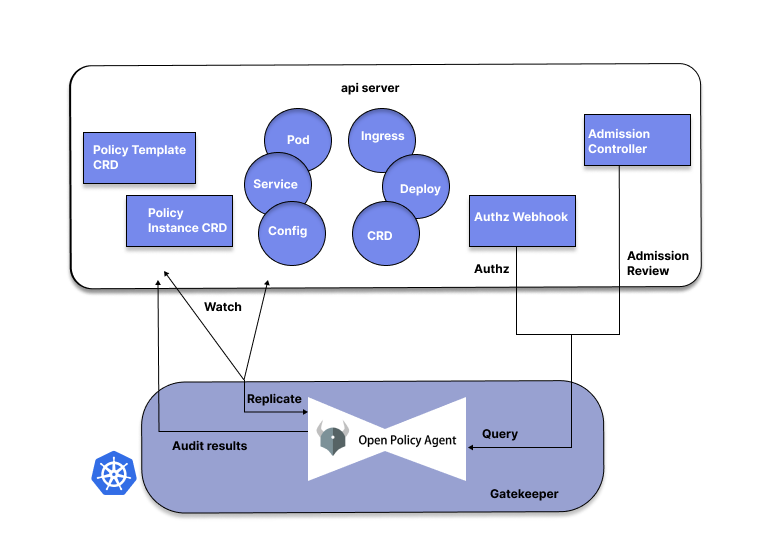
OPA gatekeeper is undoubtedly the most widely adopted tool for implementing Kubernetes policies. OPA uses a “policy-as-code” approach by decoupling the policy from the code and combining the policy enforcement. OPA uses a Domain Specific Language (DSL) called Rego to describe its policies. Gatekeeper policies run with the help of kubernetes admission controller webhooks which are triggered whenever a resource is created, updated or deleted inside a kubernetes cluster. In general Gatekeeper is a validating (mutating TBA as per official doc) webhook that enforces CRD-based policies executed by Open Policy Agent.
Kyverno:
Kyverno (meaning “govern” in Greek) is a policy engine that is specifically designed only for Kubernetes. Kyverno works by using a dynamic admission controller that verifies each and every request you send via Kubectl to the Kube API server. Then it will match the request with the policy and take appropriate action (mutate, validate, etc..) accordingly. Also, Kyverno is an open-source and a part of CNCF Sandbox Project.
Architecture:
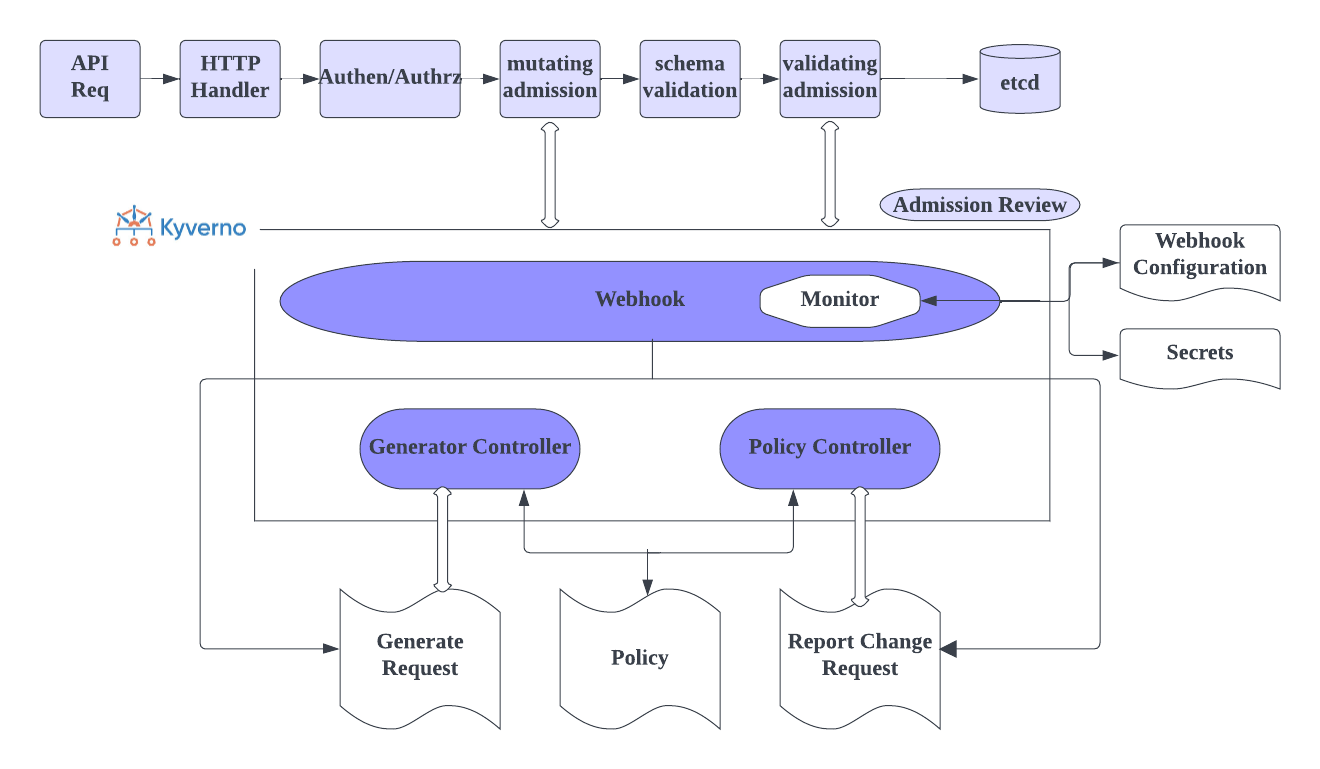
In Kyverno, policies are managed as Kubernetes resources and no new language (yaml) is required to write policies. This allows using familiar tools such as kubectl, git, and kustomize to manage policies. Kyverno policies can validate, mutate, and generate Kubernetes resources. Also, Kyverno can be used to scan the existing workloads in search of best practices or any regulation/compliance standards. The Kyverno CLI can be used to test policies and validate resources as part of a CI/CD pipeline.
Side by Side Analysis:
| OPA Gatekeeper | Kyverno |
| Advantages | |
|
|
| Disadvantages | |
|
|
Analysing Real Time Examples:
Here we use a scenario to compare both OPA Gatekeeper and Kyverno. We are using a policy that will not allow you to create a namespace that doesn’t have a specific label.
OPA Gatekeeper:
OPA Gatekeeper has been already deployed on the AKS Cluster. The OPA gatekeeper will have an audit and controller manager deployed, audit functionality will enable periodic evaluations of replicated resources against the Constraints enforced in the cluster to detect any existing misconfigurations.
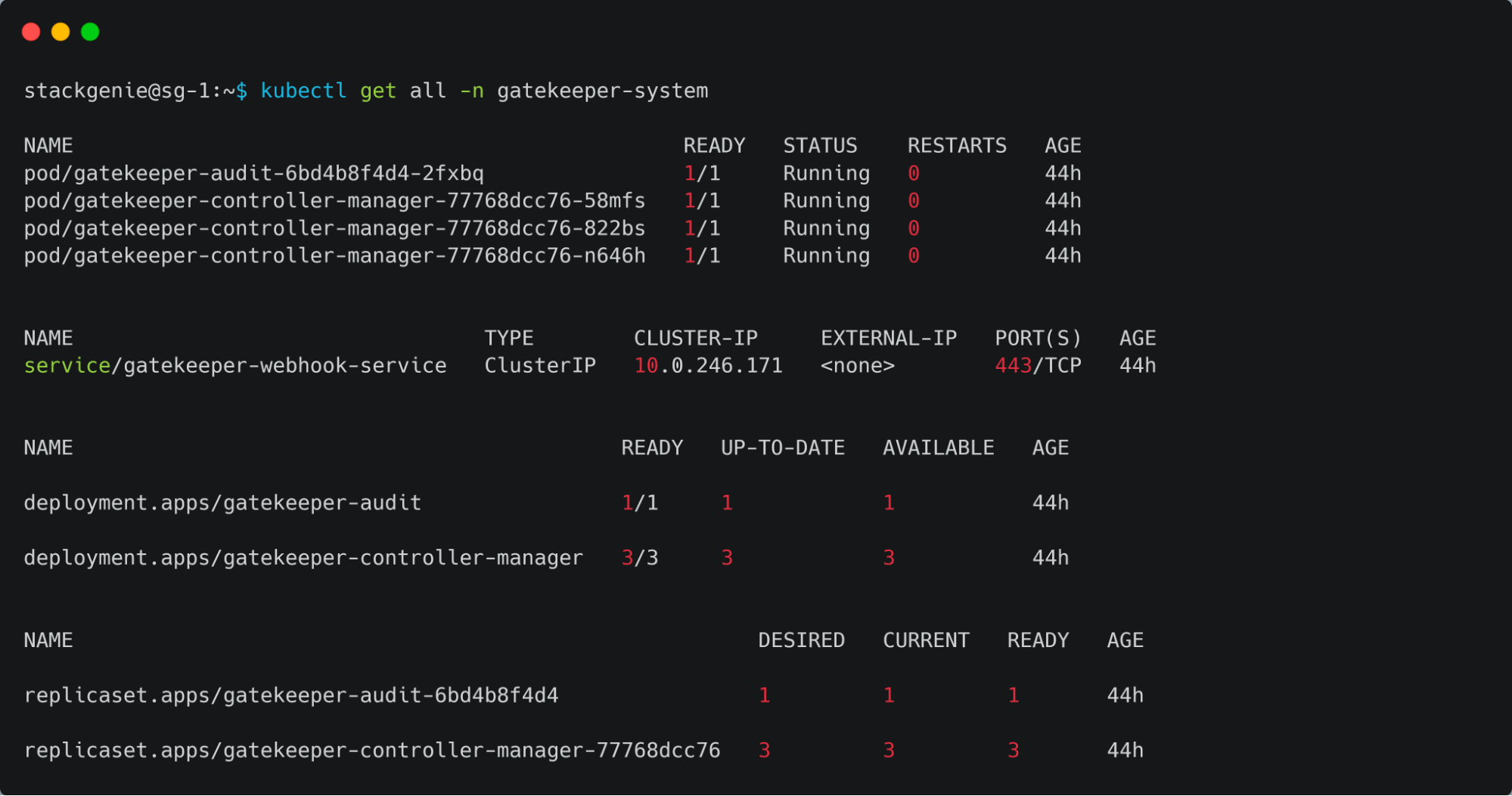
- Deploying an OPA gatekeeper policy, the OPA gatekeeper uses OPA Constraint framework to describe and enforce the policy. OPA policies have a constraint and a constraint template, you must define the constraint template first. The constraint template describes both the Rego that enforces the constraint and the schema of the constraint.
- Constraint Template that restricts the creation of namespaces that don’t have a label “gatekeeper‘.
$ kubectl apply -f k8srequiredlabels_template.yaml
constrainttemplate.templates.gatekeeper.sh/k8srequiredlabels created
k8srequiredlabels_template.yaml
apiVersion: templates.gatekeeper.sh/v1
kind: ConstraintTemplate
metadata:
name: k8srequiredlabels
spec:
crd:
spec:
names:
kind: K8sRequiredLabels
validation:
# Schema for the `parameters` field
openAPIV3Schema:
type: object
properties:
labels:
type: array
items:
type: string
targets:
– target: admission.k8s.gatekeeper.sh
rego: |
package k8srequiredlabels
violation[{“msg”: msg, “details”: {“missing_labels”: missing}}] {
provided := {label | input.review.object.metadata.labels[label]}
required := {label | label := input.parameters.labels
[_]
I am text block. Click edit button to change this text. Lorem ipsum dolor sit amet, consectetur adipiscing elit. Ut elit tellus, luctus nec ullamcorper mattis, pulvinar dapibus leo.


