
Inside this article :
“The best engineering teams don’t move faster by working harder: they move faster by removing friction.”
Modern software organizations are under constant pressure to deliver faster, scale reliably, and innovate without breaking production. Cloud-native architectures, microservices, Kubernetes, and CI/CD pipelines were supposed to simplify things, yet for many teams, they’ve done the opposite, highlighting the need for effective platform strategies.
Tool sprawl. Operational bottlenecks. Overloaded DevOps teams. Developers are spending more time debugging pipelines than building products.
This is precisely why platform engineering has emerged as one of the most critical shifts in modern DevOps and why platform engineering services are now in high demand.
In this article, we’ll break down what platform engineering really means, why it represents a turning point for engineering organizations, and how we at Stackgenie help teams build platforms that scale engineering, not complexity.
What Is Platform Engineering: Beyond the Buzzword?
Platform engineering is the discipline of designing, building, and operating internal developer platforms (IDPs) that enable software teams to deliver applications safely, consistently, and at scale.
Instead of every team figuring out infrastructure, CI/CD pipelines, security controls, and observability on their own, platform engineering centralizes these concerns into a shared, product-like platform.
The key difference?
The platform is built for developers, with usability, self-service, and reliability as first-class goals.
At its best, platform engineering:
- Abstracts infrastructure complexity
- Provides opinionated “golden paths” for delivery
- Enforces security and compliance by default
- Enables teams to ship faster without sacrificing control
This isn’t about removing DevOps; it’s about making DevOps sustainable at scale.
Why Platform Engineering Is Having Its “Golden Era”
Traditional DevOps worked well when systems were smaller and teams were tightly coupled. But as organizations grew, cracks started to show:
- CI/CD pipelines became brittle and inconsistent
- Infrastructure knowledge lived in a few people’s heads
- Developers waited on ops teams for environments and deployments
- Security reviews slowed releases late in the lifecycle
Platform engineering emerged as a response to these systemic issues.
By creating a dedicated platform team with a clear mandate, enabling product teams rather than blocking them, organizations regained speed and predictability.
This shift explains why platform engineering services are now critical for:
- Scaling engineering organizations
- Reducing operational risk
- Improving developer experience
- Supporting cloud-native and Kubernetes-heavy environments
What Platform Engineering Services Actually Deliver
Platform engineering is not just tooling; it’s an operating model. Strong platform engineering services focus on outcomes, not just technology.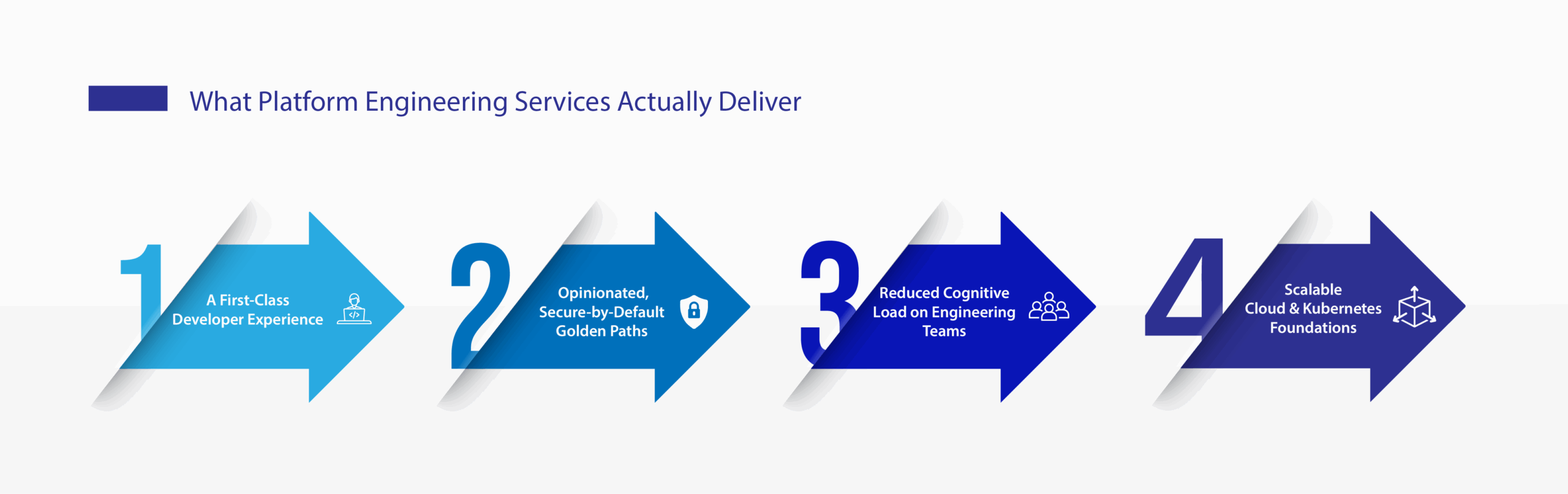 1. A First-Class Developer Experience
Developer experience (DevEx) is no longer a “nice to have.” Poor DevEx leads directly to slower delivery, higher attrition, and fragile systems.
Platform engineering services provide:
- Self-service environment provisioning
- Standardized CI/CD pipelines
- Clear deployment workflows
- Integrated logging, metrics, and tracing
Developers shouldn’t need to understand Kubernetes internals to ship code.
2. Opinionated, Secure-by-Default Golden Paths
Freedom without guardrails leads to chaos. Platform engineering introduces opinionated defaults that encode best practices:
- Secure base images
- Pre-approved deployment patterns
- Built-in compliance checks
- Automated rollbacks and failure handling
This ensures teams move fast without reinventing decisions or compromising security.
3. Reduced Cognitive Load on Engineering Teams
One of the most overlooked problems in modern engineering is cognitive overload. When developers are expected to manage infrastructure, networking, security, and observability, productivity suffers.
Platform engineering services reduce this load by:
- Hiding unnecessary complexity
- Offering clear abstractions
- Providing reliable automation
The result? Engineers spend more time solving business problems, not platform problems.
4. Scalable Cloud & Kubernetes Foundations
As companies adopt Kubernetes, multi-cloud, and microservices, operational complexity grows exponentially.
Platform engineering services help:
- Design scalable Kubernetes platforms
- Standardize cluster management
- Implement multi-environment strategies
- Ensure consistent deployment across regions and clouds
This creates a foundation that supports growth instead of slowing it down.
Our Approach to Platform Engineering Services
We at Stackgenie believe platform engineering should feel invisible when done right, enabling teams quietly, reliably, and efficiently.
Our platform engineering services are built around real-world engineering challenges, not theoretical frameworks.
Platform Design with a Product Mindset
We treat internal platforms as products, not side projects. That means:
- Understanding developer pain points
- Defining clear platform capabilities
- Measuring adoption and success
- Iterating based on feedback
A platform that developers avoid is a failed platform.
DevOps, CI/CD, and Automation; Done Right
We design and implement:
- Robust CI/CD pipelines
- Automated testing and deployment workflows
- Environment provisioning and teardown
- GitOps-based delivery models where appropriate
Everything is built to be repeatable, observable, and resilient.
Security and Compliance Embedded from Day One
Security should never be a last-minute gate. Our platform engineering services integrate:
- Identity and access management
- Policy-as-code
- Automated security scans
- Compliance guardrails
This ensures faster releases without late-stage surprises.
Cloud-Native & Kubernetes Expertise
Whether you’re running on AWS, Azure, GCP, or hybrid environments, we help design platforms that:
- Scale predictably
- Handle failure gracefully
- Support modern microservices architectures
- Enable cost visibility and optimization
Enablement, Not Dependency
We don’t just build platforms and walk away. We enable your teams with:
- Documentation and runbooks
- Knowledge transfer sessions
- Operational best practices
- Long-term support when needed
The goal is independence, not lock-in.
Who Benefits Most from Platform Engineering Services?
Platform engineering services deliver outsized value for:
- Growing startups scaling engineering teams rapidly
- Enterprises modernizing legacy DevOps practices
- Organizations adopting Kubernetes at scale
- Teams are struggling with fragmented tooling
- Companies operating in regulated environments
If your developers spend more time managing pipelines than building products, platform engineering is no longer optional.
The Future: Platform Engineering as a Competitive Advantage
Platform engineering is not a trend; it’s an organizational evolution.
As engineering organizations grow more complex, the companies that win will be the ones that:
- Enable developers instead of burdening them
- Build platforms that evolve with the business
- Treat internal tooling as a strategic asset
Platform engineering services will increasingly define how fast companies can innovate, respond to market changes, and scale sustainably.
Final Thoughts
Platform engineering is about removing friction at scale.
It’s about building systems that empower teams, standardize excellence, and make modern DevOps manageable, not overwhelming.
We at Stackgenie help organizations design and deliver platform engineering services that turn complexity into leverage and infrastructure into an enabler of growth.
If your goal is faster delivery, happier developers, and resilient systems, platform engineering is the foundation you can’t afford to ignore.
Talk to our Platform Expert?
Contact Us NowFrequently Asked Questions
1. What are platform engineering services?
Platform engineering services focus on designing and building internal developer platforms that standardize infrastructure, CI/CD pipelines, security, and observability, enabling development teams to ship software faster and more reliably.
2. How are platform engineering and DevOps different?
DevOps emphasizes collaboration and automation across development and operations, while platform engineering builds a dedicated internal platform that abstracts complexity and provides self-service capabilities for developers.
3. Why do companies need platform engineering services?
Companies adopt platform engineering services to reduce DevOps bottlenecks, improve developer experience, standardize delivery workflows, and scale cloud-native infrastructure securely.
4. What is an internal developer platform (IDP)?
An internal developer platform is a curated set of tools, workflows, and services that allow developers to self-serve infrastructure, deployments, and observability without managing underlying complexity.
5. How does Stackgenie help with platform engineering?
We at Stackgenie provide platform engineering services that include platform design, CI/CD automation, Kubernetes and cloud-native architecture, security-by-default implementations, and developer enablement.